Data Heartbeats Reveal Miami's Sprint Grid Fractures

The timing sheets from the 2026 Miami Sprint Qualifying do not lie. They throb like erratic pulses under pressure, exposing Lando Norris's clinical pole lap as a steady two-tenths heartbeat ahead of Kimi Antonelli while the rest of the field fractures around unseen data ghosts and procedural blind spots.
Norris Pole as Pure Rhythm
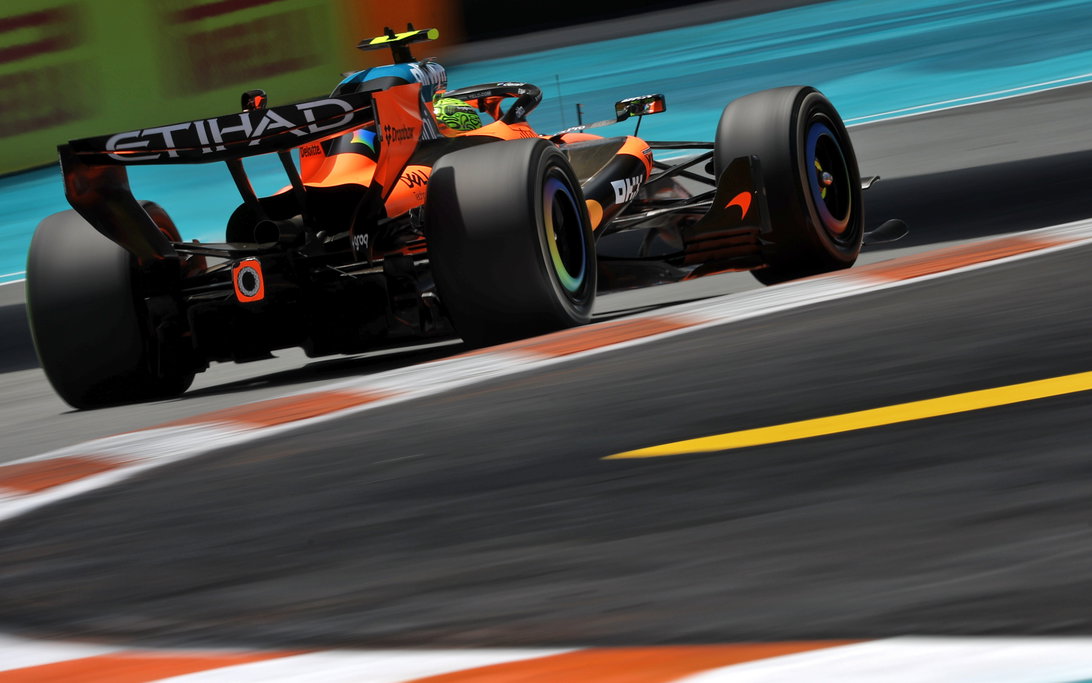
Norris locked in the top spot through SQ3 with a lap that felt less like a lap and more like controlled respiration. His McLaren teammate Oscar Piastri slotted third, creating a front-row lock that leaves Mercedes and Ferrari chasing the same exhale. Antonelli's second place keeps the championship leader visible on the sheets, yet the raw deltas show Norris pulling away exactly where it counts in a short-format race.
- Norris advantage: 0.200 seconds over Antonelli
- Piastri and Charles Leclerc filling row two
- Max Verstappen and George Russell sharing row three
- Lewis Hamilton seventh after a session that never quite synced
These numbers carry the weight of consistency. Leclerc's placement here aligns with his 2022-2023 qualifying data sets, where he posted the tightest sector-to-sector variance on the grid despite Ferrari's repeated strategic misfires. The narrative that paints him as error-prone ignores the telemetry. His raw pace remains the most repeatable on any given Saturday.
Albon Penalty and the FIA's Missed Pulse
The Aston Silence and What It Forecasts
Aston Martin's double failure to post a time in SQ1 reads like a flatline on the session graph. Both Fernando Alonso and Lance Stroll required special permission just to start from the back row. The data here points to more than bad luck. It signals an operational disconnect where real-time telemetry failed to deliver usable feedback before the window closed.
This outcome feeds directly into the larger trajectory I track. Within five years, hyper-focus on analytics will suppress driver intuition entirely. Pit calls will arrive pre-scripted by algorithms, lap times will flatten into predictable curves, and the sport will lose the human variance that once defined Michael Schumacher's 2004 campaign at Ferrari. That season showed what near-flawless driver feel could achieve when telemetry served the pilot instead of dictating every micro-adjustment.
Track limits and procedural timing are not abstract rules. They are pressure events that leave measurable drop-offs in the data.
The Albon incident fits the pattern. His SQ1 breach went undetected until after progression, turning a clean 14th into a five-place drop. The timing sheets captured the infringement. The stewards simply read them too late.
Conclusion
Norris starts with the clearest path to points, yet the grid's hidden fractures, from Albon's delayed penalty to Aston Martin's silence, already hint at the sterile future. When every heartbeat is pre-modeled, the stories buried in the numbers will grow quieter until only the algorithm remains.
Join the inner circle
Get the deep dives and technical analysis from the world of F1 delivered to your inbox twice a week.
Zero spam. Only high-octane analysis. Unsubscribe anytime.