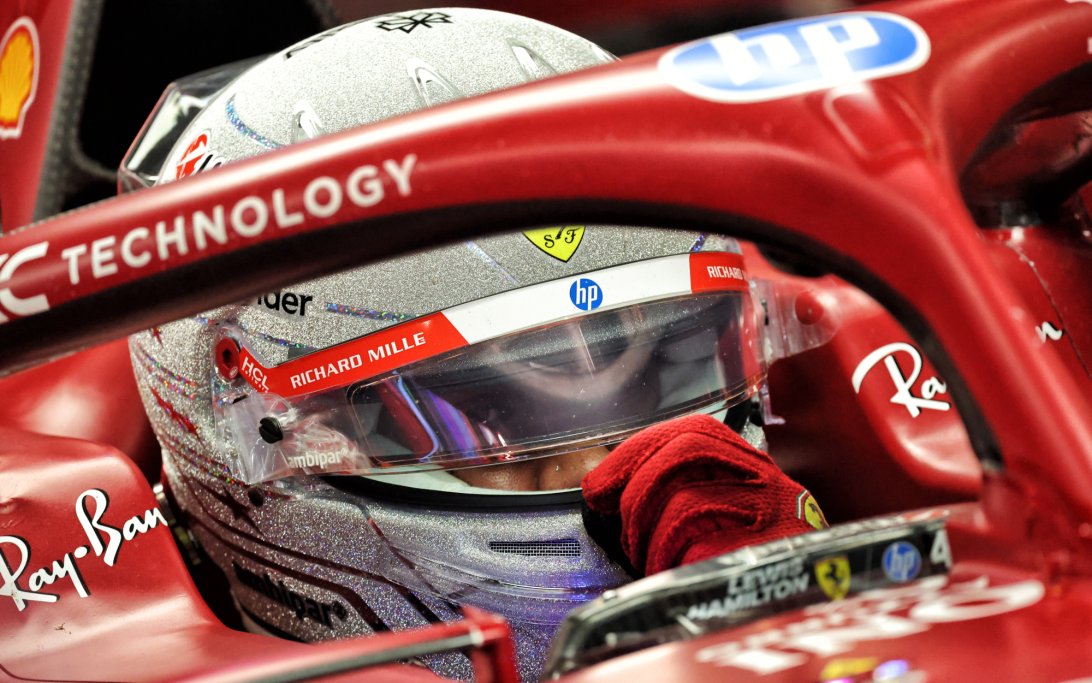
Button and Collins Defend Ferrari Amid Hamilton's Vegas Q1 'Confusion'
Lewis Hamilton started last at the Las Vegas Grand Prix after mistakenly aborting his final Q1 lap due to a dashboard 'red light,' believing he missed the timing line. Both Jenson Button and Bernie Collins defended Ferrari, clarifying the distinction between the timing line and the red light gantry. Collins noted Ferrari's pit wall had urged Hamilton to 'keep pushing,' but the driver's snap decision led to a career-first P20 start on pure pace.
Jenson Button and Bernie Collins have come to the support of Ferrari after the "confusion" surrounding the start of Lewis Hamilton's last push lap in Q1 at the Las Vegas Grand Prix. The seven-time F1 drivers' champion aborted what could have been a final effort, incorrectly believing he had failed to reach the timing line in time to open a new lap as his dashboard flashed red. It consigned him to P20 and last on the grid, having set the slowest time in the rain-soaked first qualifying session under the lights of Sin City.
Why it matters:
Lewis Hamilton's P20 start in Las Vegas Q1 marked a career-first humiliation, placing him last on pure pace. The incident, stemming from a misinterpretation of timing lights and a communication breakdown, highlights the immense pressure and split-second decisions F1 drivers and teams face, especially in challenging conditions like the rain-soaked Las Vegas track.
The Details:
- Hamilton's Error: During Q1, Hamilton aborted his final flying lap, mistakenly believing he had not crossed the timing line in time for another attempt. His dashboard flashing red led to this incorrect assumption.
- Career First: This error resulted in a P20 start, marking the first time in his F1 career that Hamilton started from the back of the grid purely due to pace, not penalties or mechanical issues.
- Initial Conditions: The qualifying session was held in challenging, rain-soaked conditions, contributing to the chaotic environment.
- Hamilton's Justification: Hamilton later stated he didn't feel the lap would have made much difference, citing an earlier yellow flag and contact with a bollard.
- Button's View: Jenson Button emphasized the importance of drivers continuing until explicitly told to stop, regardless of dashboard lights, noting that the timing line is distinct from the red light gantry.
- Collins' Defense of Ferrari: Former Aston Martin strategist Bernie Collins defended Ferrari's pit wall. She highlighted that Hamilton's race engineer, Riccardo Adami, had instructed him to "keep pushing to get another lap" earlier in the lap, indicating it would be tight but possible.
- Radio Exchange: When Hamilton asked if he was safe after crossing the line, Adami told him to "keep pushing." Hamilton then cited the "red light," to which Adami again said, "No, keep pushing." However, by then, Hamilton had already lifted off, making further instruction futile.
- Timing Line vs. Red Light: Both Button and Collins stressed that the timing line (where lap times are registered) is in a different location from the red light gantry (which indicates the end of a session or other procedural markers), a distinction drivers should be aware of.
Between the lines:
The incident underscores the razor-thin margins and the mental load on F1 drivers. Even a veteran like Hamilton can be caught out by complex regulations and the need for instantaneous decision-making under pressure. It also highlights the critical role of clear, unambiguous communication between driver and pit wall, especially when conditions are deteriorating and every millisecond counts.
What's next:
While the immediate fallout was a disappointing P20 start for Hamilton in Las Vegas, the incident serves as a crucial learning point for both drivers and teams regarding operational protocols in high-stakes qualifying sessions. The discussions around the timing line versus the red light gantry may prompt teams to review and reinforce driver briefings on these specific procedural nuances to prevent similar errors in the future.