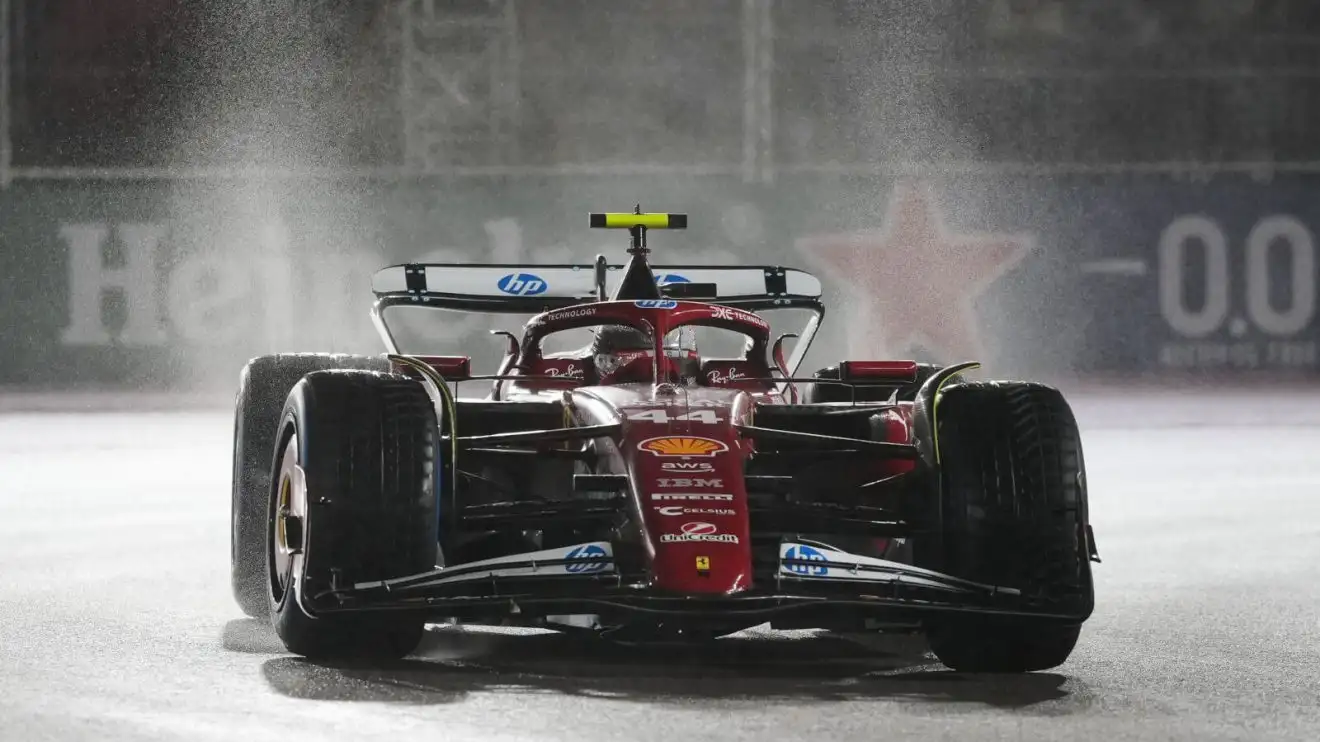
Hamilton Faces Career-First Last-Place Start in Las Vegas GP Qualifying
Lewis Hamilton will start the Las Vegas Grand Prix from a career-first last place (P20) after a challenging, rain-affected qualifying session. Poor visibility led to him hitting a bollard and encountering a yellow flag on his crucial final lap. This significant setback complicates his race strategy and push for points, making his performance on Saturday a major focus for Mercedes and F1 fans.
Lewis Hamilton will start Saturday night's Las Vegas Grand Prix from the 20th and last position on the grid after a challenging, rain-affected qualifying session on Friday. His final lap time of 1:57.115 placed him over three-tenths behind Yuki Tsunoda, who will start 19th.
Why it matters:
Hamilton's last-place start marks a significant and rare setback for the seven-time World Champion, who rarely finds himself at the very back of the grid. This result drastically complicates his race strategy and ability to score points in the highly anticipated Las Vegas Grand Prix, putting immense pressure on Mercedes to devise a recovery plan for Saturday night's race.
The details:
- Challenging Conditions: The qualifying session was heavily impacted by rain in Sin City, leading to minimal visibility and difficulties in maintaining tire temperature on the full wet Pirellis.
- Bollard Incident: During his final run in Q1, Hamilton's warm-up lap was compromised when he collided with a bollard at Turn 14. This incident, as noted by former F1 driver Anthony Davidson, likely affected his car's performance for the subsequent flying lap.
- Hamilton himself stated he 'couldn't see anything' and 'hit the bollard' due to the poor visibility.
- Yellow Flag Impact: Despite feeling confident after a strong FP3, Hamilton encountered a yellow flag in the final corner of his last qualifying lap, forcing him to lift. He acknowledged, however, that the grip issues might have limited his progress regardless.
- Performance Gap: His qualifying time of 1:57.115 was insufficient to advance, leaving him at the bottom of the Q1 timesheets.
Between the lines:
Hamilton described his P20 as 'horrible' and 'as bad as it gets,' reflecting the frustration of a season he's called 'definitely the hardest year.' Despite the setback, he expressed confidence in the car's potential for the race, calling it 'a really good car,' but acknowledged the immense challenge of fighting back from 20th.
What's next:
Hamilton faces an uphill battle in the Las Vegas Grand Prix, needing a strong performance and potential safety car interventions to climb through the field. Mercedes will be working overnight to optimize strategy and car setup to maximize his chances of salvaging points from the back of the grid. His ability to navigate traffic and manage tire degradation will be critical in what promises to be a dramatic race night.