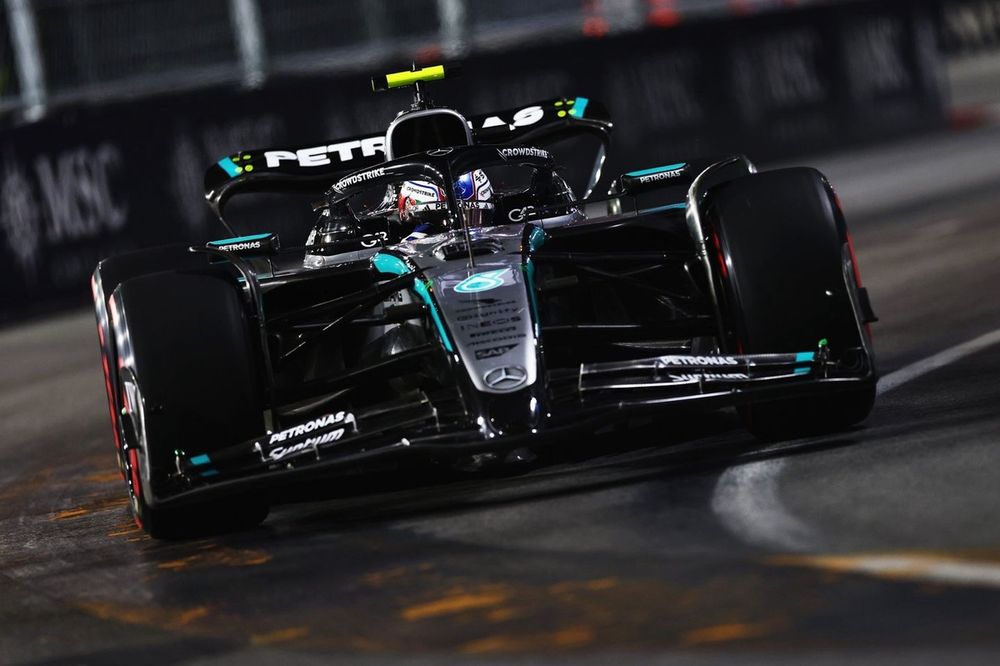
Mercedes Explains Antonelli's Las Vegas Jump-Start Penalty
Mercedes has clarified Andrea Kimi Antonelli's jump-start penalty at the Las Vegas Grand Prix, explaining that the rookie's car rolled forward a mere two centimeters due to lifting off the brakes, not from dropping the clutch. This marginal movement, detected by highly sensitive FIA systems, nearly cost him a podium despite an impressive recovery drive, highlighting the extreme precision required in F1 starts.
Mercedes has clarified the controversial jump-start penalty incurred by Andrea Kimi Antonelli during the Las Vegas Grand Prix, a decision that nearly cost the rookie driver a podium finish. Despite Antonelli's strong recovery drive, the minimal infraction created a close call for his third-place inheritance.
Why it matters:
Andrea Kimi Antonelli's jump-start penalty in Las Vegas highlights the extreme precision and sensitivity of Formula 1's starting detection systems. This incident underscores how even the slightest unintended movement can trigger a penalty, potentially altering race outcomes and championship standings for drivers and teams, especially in a rookie's crucial development phase.
The details:
- Antonelli's car was detected moving forward approximately two centimeters before the lights went out in the Las Vegas Grand Prix.
- Mercedes trackside engineering director Andrew Shovlin explained that Antonelli did not drop the clutch, which is the typical cause of a jump start. Instead, he had the clutch fully pulled.
- Cause of Movement: Mercedes believes the car rolled forward at the precise moment Antonelli lifted his foot off the brakes, about a second before the start lights extinguished.
- This movement is attributed to either car vibration or residual torque in the driveline, rather than an intentional action by Antonelli.
- FIA System Sensitivity: Shovlin noted that the FIA's systems are highly sensitive, capable of detecting even minimal motion, which was later confirmed by a subtle video review.
- Antonelli himself was confused post-race, stating he didn't feel any movement in the car, suggesting a very slight, almost imperceptible roll.
- The penalty nearly cost Antonelli a podium finish; he inherited third place after McLaren's disqualification, finishing just 0.190 seconds ahead of Charles Leclerc.
The big picture:
This incident is a prime example of the razor-thin margins in Formula 1, where technology scrutinizes every millisecond. For a rookie like Antonelli, who has been on an impressive scoring streak—accumulating 71 points in the last six rounds compared to 66 in the first 16—such a penalty, while marginal, could be a significant learning curve. He is currently only 15 points behind Lewis Hamilton for sixth in the drivers' championship, underscoring the importance of every point and every perfect start.
What's next:
Mercedes will analyze this unique jump-start to prevent similar occurrences in the future, ensuring Antonelli can focus on maximizing his race starts without unintended movements. The team aims to adjust procedures to account for the FIA's ultra-sensitive detection systems, allowing Antonelli to continue his strong performance trajectory without such close calls impacting his results.