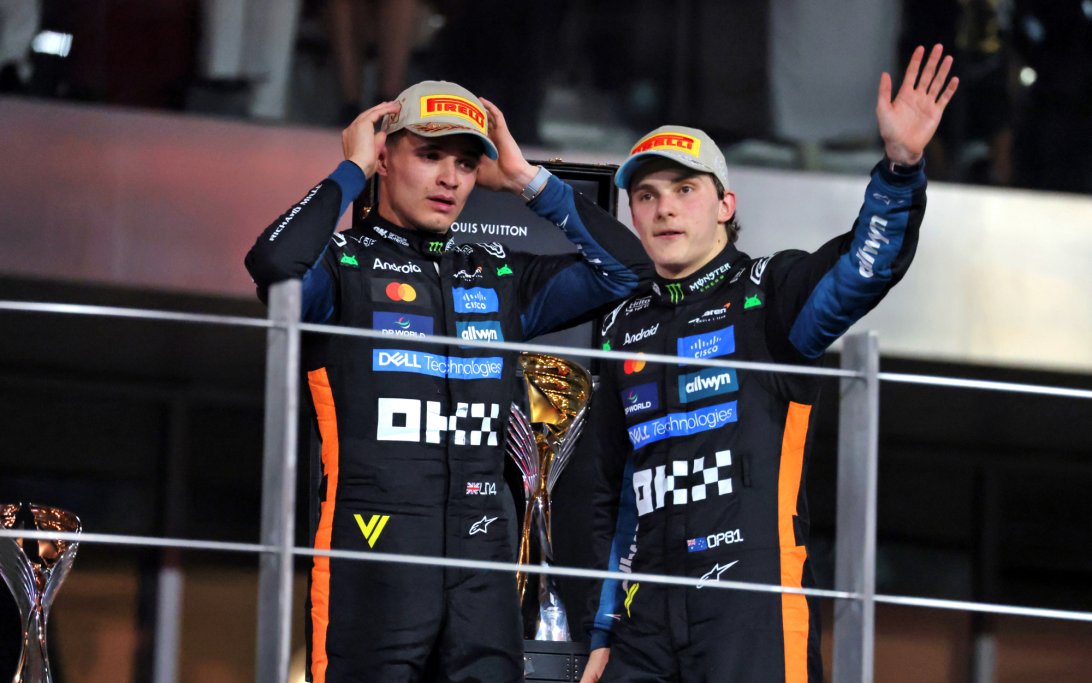
Norris Credits Piastri's Abu Dhabi Strategy as Key to F1 Title Win
McLaren's coordinated tire strategy with Piastri starting on hard tires pressured Verstappen, enabling Norris to clinch the F1 title by 2 points despite finishing third. Norris called his teammate 'as much a part' of the championship success, revealing how Piastri's opening-lap move disrupted Red Bull's race control.
Lando Norris secured his first F1 drivers' championship by a razor-thin two-point margin after finishing third at the Abu Dhabi Grand Prix, with teammate Oscar Piastri's strategic tire choice proving decisive against Max Verstappen. The Australian's hard-compound start—part of McLaren's pre-race contingency plan—forced Verstappen into early defensive maneuvers, preventing the Red Bull driver from controlling the race pace to back Norris into traffic.
Why it matters:
This tactical masterstroke highlights how modern F1 championships are won through team coordination rather than individual brilliance alone. While Verstappen dominated the race, McLaren's ability to deploy Piastri as a strategic counterweight neutralized Red Bull's advantage in racecraft—a critical factor in Norris' narrow title victory. The move underscores McLaren's evolution from a team plagued by internal friction to one executing sophisticated, championship-caliber teamwork.
The details:
- Piastri started on durable hard tires while Norris used mediums, creating an intentional performance offset that allowed the Australian to immediately challenge Verstappen after storming around the outside of Norris at Turn 9 on lap one.
- Norris confirmed the strategy was pre-discussed though not rigidly scripted: "There wasn't an exact plan, but I was very happy letting Oscar go. He started on the hard to try and push Max into doing something."
- The tactic successfully prevented Verstappen from executing his preferred race management—specifically, backing Norris into the chasing pack to compromise his championship position—forcing the Dutchman to maintain higher speeds than optimal.
- Norris emphasized Piastri's indispensable role: "Oscar was just as much a part of trying to achieve what we've achieved, and I have to thank him for that," acknowledging how the move secured his title despite Piastri finishing second in both race and championship.
- The British driver expressed regret that Piastri couldn't win the race—which would have simultaneously secured second in the championship for the Australian—calling it "a shame" and admitting he "really hoped" for that outcome.
What's next:
This championship-winning collaboration sets a new benchmark for teammate dynamics in F1's hybrid era. With both drivers under contract through 2026, McLaren now faces the delicate task of maintaining this cooperative spirit while addressing Piastri's win drought—his last victory coming at Zandvoort in August. The Abu Dhabi strategy demonstrates how tire management and teammate coordination have become as critical as raw speed in title battles, suggesting future championships may hinge on which team best leverages dual-car tactics against dominant rivals like Red Bull. As Norris noted, the championship was won not just through his own consistency, but through McLaren's ability to transform potential intra-team conflict into strategic synergy—a lesson that will undoubtedly shape team approaches for seasons to come.