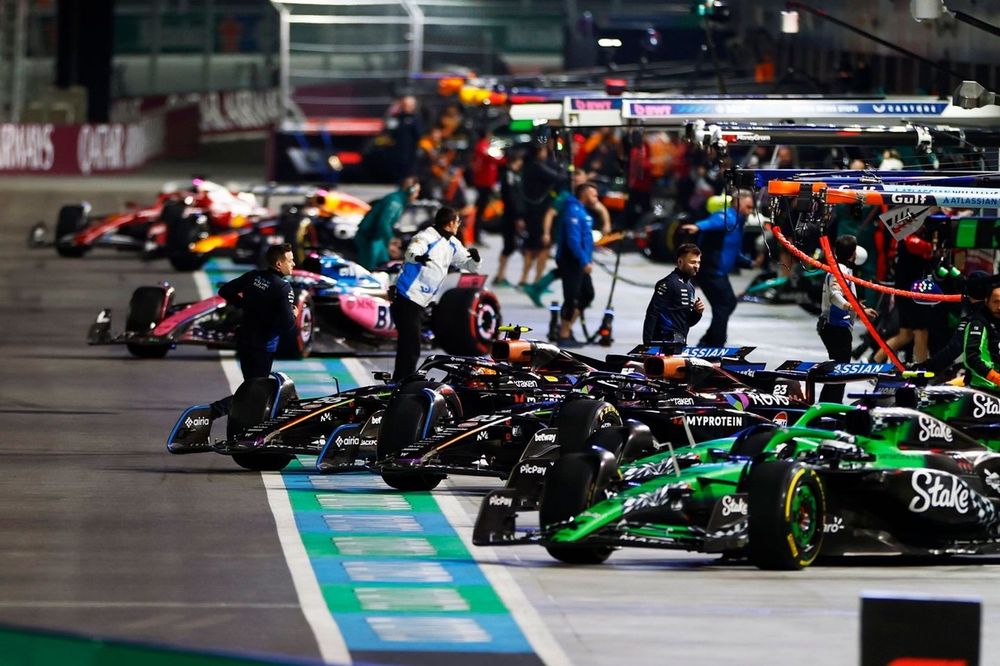
Pirelli Undecided on Optimal F1 Strategy for Las Vegas GP
Pirelli admits uncertainty regarding the best strategy for the Las Vegas Grand Prix due to a wet qualifying and disrupted practice sessions, leaving teams with minimal data. With both one-stop and two-stop strategies looking equally viable, and high risks of tire graining, the race is set to be a strategic gamble, demanding flexibility and real-time decision-making from all teams.
Pirelli is uncertain about the best strategy for the Las Vegas Grand Prix after a rain-affected Formula 1 qualifying session provided minimal valuable data. Drivers faced extremely low-grip conditions on intermediate or full-wet tires in the cold Vegas night, with many describing it as the worst they'd experienced in F1. This lack of representative data, combined with a dry race forecast and disrupted practice sessions, leaves teams with significant strategic dilemmas for the inaugural Las Vegas GP.
Why it matters:
The Las Vegas Grand Prix is set to be a strategic gamble due to unprecedented data scarcity. With qualifying held in wet conditions and practice sessions compromised by red flags and unrepresentative timing, teams lack crucial information on tire degradation, grip levels, and optimal pit windows. This uncertainty could lead to diverse and unpredictable race strategies, potentially shaking up the grid and creating an exciting, chaotic race.
The details:
- Wet Qualifying: The qualifying session took place in cold, wet conditions, forcing drivers onto intermediate or full-wet tires. This scenario provided no useful data for a predicted dry race.
- Limited Practice Data:
- FP1 and FP3 started hours before the race, making their data less relevant for expected race conditions.
- FP2 was heavily disrupted by red flags, preventing teams from completing essential long-run simulations.
- Tire Compounds: Pirelli supplied C3 (hard), C4 (medium), and C5 (soft) compounds for the event.
- Graining Concerns: Pirelli's motorsport boss, Mario Isola, highlighted that graining – particularly on the front tires – is a major concern on the 'green' (low-rubber) track. Early heavy pushing could initiate graining, leading to significant degradation and understeer.
- Strategic Dilemma: Both one-stop and two-stop strategies appear very close in terms of total race time. Teams will need to be flexible.
- One-stop: The quickest theoretical strategy involves starting on mediums and switching to hards between laps 20 and 26. This is often preferred for track position.
- Two-stop: A medium-hard-hard strategy is very close in total race time to a one-stop. If graining becomes unmanageable, a two-stop could be advantageous, allowing for fresh tires and potential undercuts. Other two-stop options include soft-medium-soft, though few drivers have two sets of medium tires available.
What's next:
Teams will have to rely heavily on real-time data and driver feedback during the race to make critical strategy calls. The unknown grip levels, the potential for graining, and the challenge of overtaking on the street circuit will all play a role in determining the most effective approach. The inaugural Las Vegas Grand Prix is poised to be a tactical battle where adaptability and quick thinking will be paramount for success, making it a truly unpredictable spectacle for fans and teams alike.