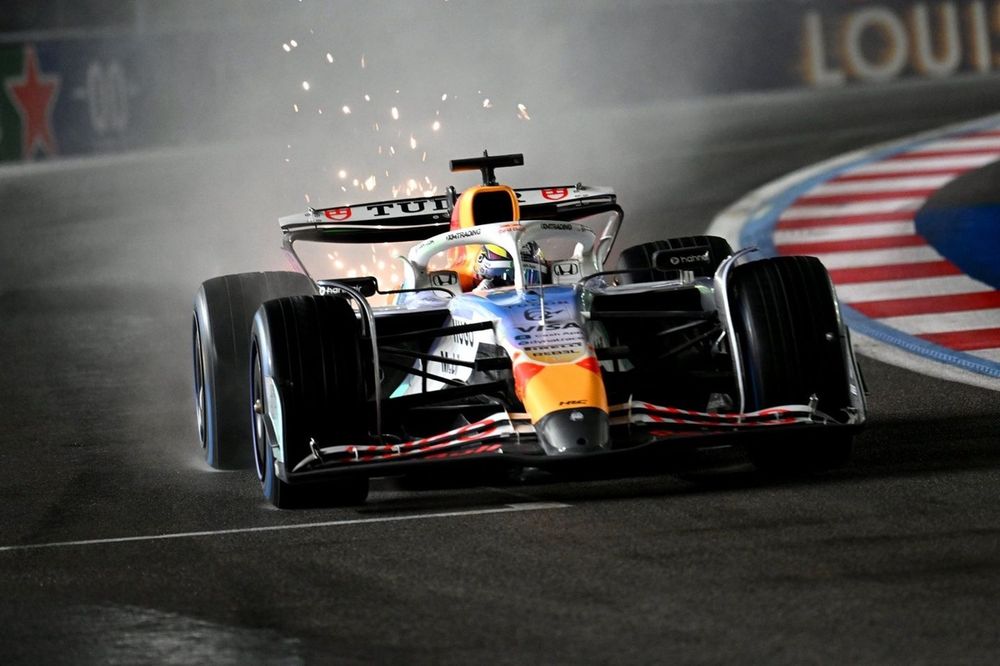
Unpacking F1 Las Vegas GP's 'Worst Conditions Ever'
The Las Vegas Grand Prix's first rainy qualifying session revealed extreme low grip conditions, making it one of the most challenging F1 events ever. A 'perfect storm' of factors—the track's unique layout, cold weather, and its dual use as a public road—contributed to the treacherous environment. Despite the difficulties, drivers exhibited exceptional skill, avoiding major incidents and highlighting the high caliber of talent in Formula 1.
The Las Vegas Grand Prix, for the first time since its 2023 debut, saw its Friday practice and qualifying sessions impacted by rain, transforming the high-speed street circuit into a treacherous challenge. Drivers described the grip levels as exceptionally low, leading to a mix of fear and thrill among the grid.
Why it matters:
Rain on a street circuit like Las Vegas creates a unique and extreme challenge, highlighting the raw skill of F1 drivers while also exposing the inherent difficulties of a track that doubles as public roads. This incident provides critical insights into how F1 cars perform under unexpected, adverse conditions on unconventional layouts, influencing future track design and safety protocols.
The Details:
- Extreme Low Grip: Drivers universally reported unprecedentedly low grip levels. Pierre Gasly admitted, "I don't think I'm going to sleep tonight with the amount of adrenaline I still have in me. It's crazy conditions." Even wet-weather specialist Max Verstappen found the conditions "a little bit too much," stating, "It's already slippery in the dry but in the wet – yeah, it's not fun, I can tell you that."
- Rookie Reactions: Haas's Ollie Bearman called it "the worst I've ever experienced in my life," a sentiment echoed by other rookies. More experienced drivers, like George Russell, compared it to the infamous 2020 Turkish Grand Prix, known for its extremely slippery resurfaced track.
- Split Opinions on 'Fun': While some drivers, particularly rookies like Isack Hadjar, relished the challenge, most veterans found it nerve-wracking. Hadjar remarked, "I never got to really try myself in the rain in an F1 car, so today was the first time, and honestly I enjoyed it very much."
- The 'Perfect Storm' of Factors:
- Track Layout: The combination of long straights and 90-degree corners, including the mile-long Strip, makes it difficult for tires to generate and maintain optimal temperature without sufficient lateral loads.
- Chilly Conditions: Cold November temperatures exacerbated the challenge of keeping Pirelli tires in their narrow operating window, leading drivers to experiment with double warm-up laps.
- Track Surface: While some suggested the road car-designed tarmac was a factor, Esteban Ocon argued the primary issue was the lack of heat generation due to the track's layout rather than the surface itself. The track was resurfaced for the 2023 inaugural race, with white lines minimized by the FIA.
- Public Road Usage: The majority of the track, including the Strip, reopens to public traffic nightly. This constant use by road cars deposits oil and debris, effectively resetting track evolution and creating greasy patches that become particularly hazardous in the rain. Pirelli F1 chief Mario Isola noted, "When we came here on Wednesday the surface was greasy."
Between the lines:
Despite the daunting conditions, the session saw remarkably few major incidents. Alex Albon was the only driver to make significant contact with the wall but managed to limp back to the pitlane, avoiding a red flag. This surprisingly smooth running, amidst such challenging circumstances, underscored the exceptionally high skill level across the current F1 grid. Verstappen remarked, "Honestly, I was surprised there were not too many incidents. So everyone was behaving quite well, or scared!" Gasly added that it was "one of the toughest sessions I've had in Formula 1," and credited the lack of crashes to the drivers' immense talent.
What's next:
This experience will likely prompt further review of street circuit characteristics and their interaction with weather, especially in colder climates. Teams will analyze data to better prepare for similar conditions in the future, while organizers may consider adjustments to mitigate the unique challenges posed by multi-purpose public roads under adverse weather. The successful navigation of these extreme conditions by drivers further solidifies their reputation for handling immense pressure and danger at the pinnacle of motorsport.