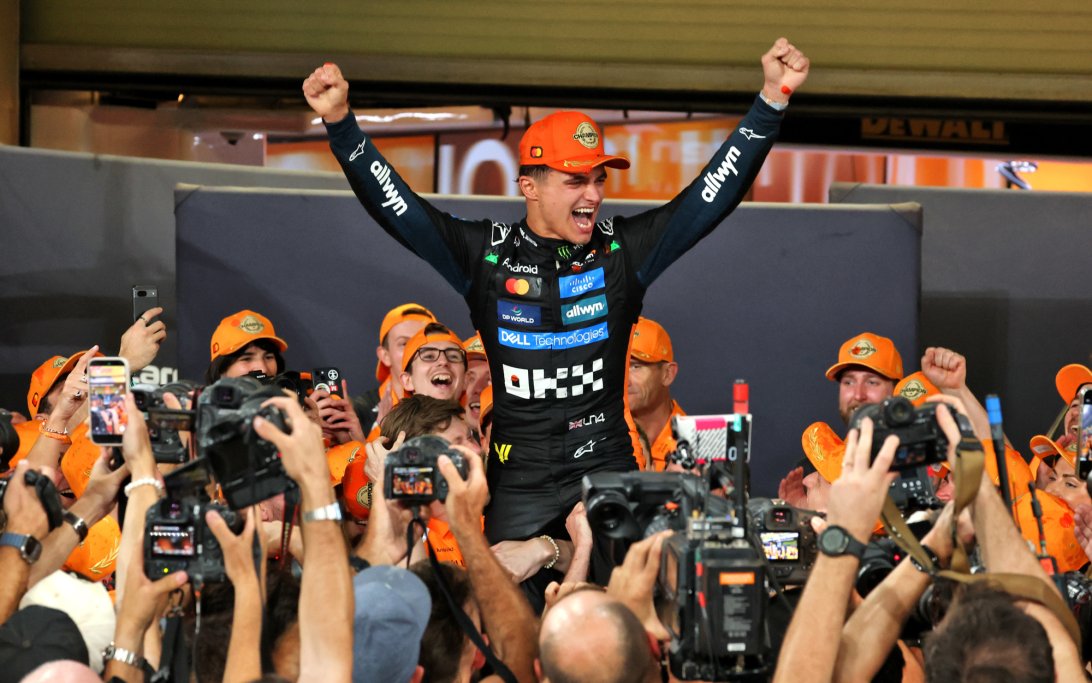
Why History Suggests Lando Norris Faces a Tough Title Defense in 2026
Lando Norris must defend his first F1 title under the radically new 2026 regulations, a scenario where history is not on his side. Past first-time champions like Jacques Villeneuve and Lewis Hamilton saw their reigns falter dramatically after similar technical resets, as their teams failed to adapt. Norris and McLaren now face the ultimate test of translating championship momentum into success in a completely new era of the sport.
Lando Norris will defend his maiden Formula 1 drivers' championship under the sweeping new 2026 technical regulations, a scenario that has historically proven far more challenging than a standard title defense. As the sport prepares for a complete reset, Norris finds himself in a position that has repeatedly derailed first-time champions when the competitive order is rewritten.
Why it matters:
Defending a title is always difficult, but doing so during a major regulatory overhaul adds a layer of complexity that can neutralize a champion's advantage overnight. Success in this context depends less on a driver's current form and more on their team's ability to interpret entirely new rules correctly from the start. For Norris and McLaren, the 2026 season will be the ultimate test of whether their championship-winning momentum can survive a complete technical revolution.
The details:
- Jacques Villeneuve's 1998 Collapse: After winning the 1997 title with Williams, Villeneuve faced new aerodynamic rules, narrower cars, and grooved tires. Williams failed to adapt, and Villeneuve went winless, finishing fifth in the standings—a stark example of how quickly rules can dismantle a winning combination.
- Lewis Hamilton's 2009 Struggle: Following his 2008 championship, Hamilton entered a season with radically altered aerodynamics, slick tires, and the new KERS system. McLaren misjudged the car's balance, producing an unstable and inefficient machine. Hamilton spent most of the year outside podium contention, finishing fifth despite late-season improvements.
- Other Champion Setbacks: Even experienced champions like Michael Schumacher (2005) and Sebastian Vettel (2014) saw their dominance end abruptly due to regulation tweaks or new power unit eras that their teams failed to master initially.
- The Rosberg Exception: Nico Rosberg retired after winning the 2016 title, but Mercedes remained competitive under the 2017 rules. His case shows that a successful defense is possible if the team nails the new regulations, but it remains the exception.
What's next:
The 2026 changes are particularly extreme, featuring a 50/50 power unit energy split, active aerodynamics, and lighter, smaller cars. Very little carries over from 2025, placing immense pressure on McLaren's design and engineering departments. Norris's newly earned status will bring confidence, but history indicates that first-time champions face the steepest learning curve when the technical slate is wiped clean. Winning in 2025 was his breakthrough; succeeding in 2026 against this historical precedent would be his defining achievement.