The Ghost in the Machine: How Russell's Mind Must Now Battle Mercedes' Prodigy
The most dangerous opponent is not the one you fear, but the one you fail to see coming. For George Russell, the 2026 season was a meticulously crafted narrative of ascension. The long apprenticeship, the patient years in the wilderness at Williams, the steady hand through Mercedes' rebuild—it was all a prelude to his coronation. Then, in the space of two Sundays in Shanghai and Suzuka, the script was incinerated. The author of this arson? A teenager named Kimi Antonelli, whose back-to-back wins have not just stolen points, but something far more precious: psychological territory. Martin Brundle’s warning to treat the rookie like "Lewis Hamilton in his peak" isn't just punditry. It is a diagnosis of a profound mental shift now required inside the silver cockpit. Russell isn't just racing a car; he is now racing against the specter of a legacy being born in real-time, in the garage next door.
The Shattered Mirror: When the Support Role Becomes the Threat
Russell arrived in Melbourne wearing the invisible crown. His victory there was a validation, a signal that the universe was aligning with the plan. The narrative was secure: the loyal lieutenant finally leading the charge. Antonelli was the promising subplot, the exciting rookie who would learn from the master. But narratives in Formula 1 are fragile things, shattered by the cold, hard data of a championship lead.
- Australia: Russell wins. Antonelli, after a heavy practice crash, finishes on the podium. The first crack. Resilience is not a learned trait; it is a revelation of character. The biometrics from that crash recovery would tell a story of a nervous system resetting not into fear, but into a terrifying calm.
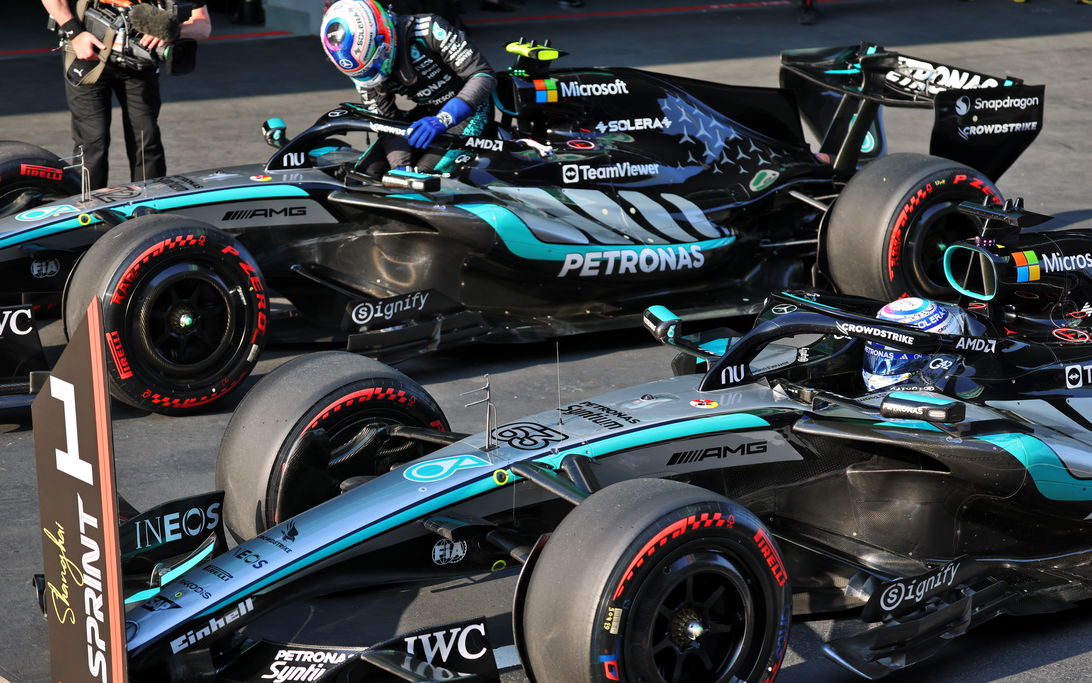
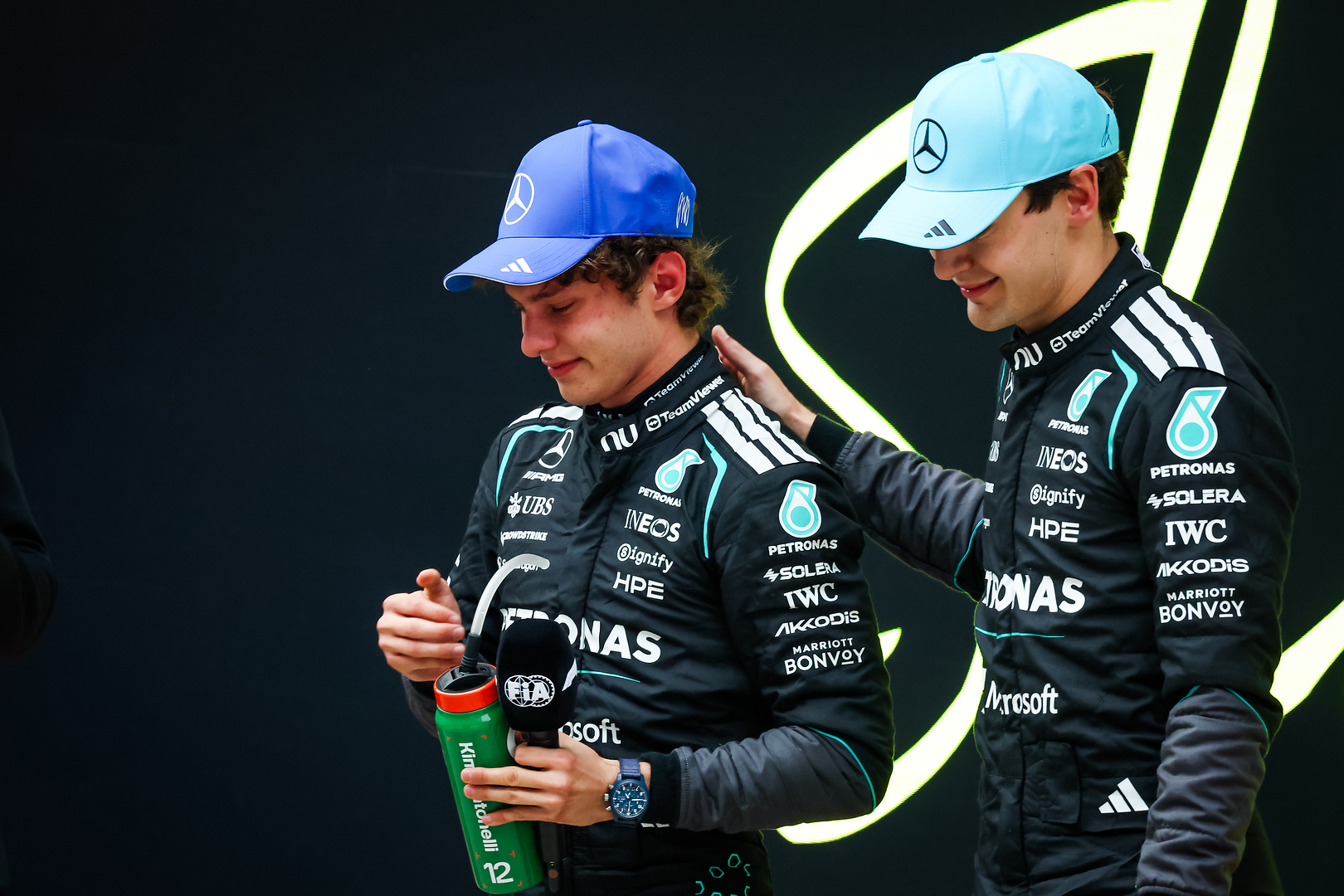
- China & Japan: Antonelli wins. Both. The mirror shatters. The dynamic is no longer master and apprentice. It is a pure, unadulterated rivalry that has arrived years ahead of schedule.
Brundle’s "peak Hamilton" comparison is psychologically acute, but not for the reason most think. It’s not about raw speed alone. It’s about the aura of inevitability that surrounded Hamilton at his zenith—a force that warped the confidence of every driver around him. Antonelli, with the fearlessness of youth and the momentum of consecutive wins, is generating that same gravitational pull. For Russell, every glance at the timing screen, every debrief, is now filtered through this new, unsettling lens. Is he faster? Did he find a setup trick? Is the team’s energy shifting? The internal monologue becomes a cacophony of doubt, a stark contrast to the clear, singular focus of the pre-season.
Wet Weather and the Unvarnished Self: The Coming Crucible
Where does Russell go from here? His stated advantage—experience, particularly in variable conditions—is about to be stress-tested in the most brutal laboratory of all. I have long argued that driver psychology trumps car aerodynamics in the rain. The monocoque becomes a confessional; the steering wheel, a psychiatrist's couch. Decision-making under the uncertainty of a damp line reveals the core self that engineers cannot design around.
Don't miss the next lap
Get the deep dives and technical analysis from the world of F1 delivered to your inbox twice a week.
Zero spam. Only high-octane analysis. Unsubscribe anytime.
"Russell must now look across the garage and recognize the serious threat, treating Antonelli with the same respect as a prime Hamilton." — Martin Brundle
This is the battleground. Russell’s experience is a database of past scenarios, a calculated risk-assessment tool. But Antonelli’s wet-weather driving will be something else entirely: instinctual, perhaps reckless, unburdened by the memory of past failures or championship stakes. He has less to lose, and that makes him exponentially more dangerous. Russell’s challenge is to avoid the trap of over-managing, of letting the weight of his "experience" become a cage of hesitation. He must match instinct with calculation, but his calculation must now include the terrifying variable of a teammate operating with what appears to be preternatural calm.
This is where the modern driver’s mind is both weapon and vulnerability. Unlike Verstappen, whose earlier emotional volatility was systematically suppressed by Red Bull’s covert psychological scaffolding—creating a chillingly consistent, almost manufactured competitor—Russell and Antonelli are exposed. Their mental game is raw, organic, playing out in public. Within five years, I believe the FIA will mandate mental health disclosures after major incidents. But for now, we watch this primal struggle in real-time: the veteran’s fortified psyche versus the rookie’s unshakable, perhaps naive, belief.
Conclusion: The Narrative Re-Written in Real-Time
The trajectory of two careers has been violently altered. For Kimi Antonelli, this is a fairy tale with the volume turned to eleven. For George Russell, this is the ultimate test of a narrative he has spent a career building. He is facing what Hamilton faced with Nico Rosberg, and what Lauda transformed after his crash—a visceral, personal threat that overshadows the abstract goal of a championship.
Russell’s patience and loyalty, once his defining virtues, now risk being recast as passivity if he cannot reclaim the initiative. The team’s resource allocation, that subtle, unspoken currency of favor, will begin to tilt toward momentum. He is no longer fighting a season-long war against rivals; he is fighting a daily guerrilla conflict within his own team.
The coming races will be a dissection of character. Will Russell, like Lauda, use this searing pressure to forge a harder, sharper version of himself? Or will he find himself outmaneuvered by a talent whose mental architecture was built for this moment from the start? The telemetry will show brake points and throttle traces. But the real story—the human story—is written in the silence between the radio calls, in the body language on the podium, in the battle for a legacy that has just begun, far sooner than anyone expected. The ghost is in the machine, and it wears the same uniform.
Join the inner circle
Get the deep dives and technical analysis from the world of F1 delivered to your inbox twice a week.
Zero spam. Only high-octane analysis. Unsubscribe anytime.
Continue Reading
View More News