The Data's Pulse: How Melbourne's Chaos Proved We're Already Racing Like Machines

I spent the morning after the Australian Grand Prix not watching the highlights, but staring at a spreadsheet. The final classification from Albert Park is just a sterile list of names and numbers: P1: G. Russell, P3: C. Leclerc, P8: A. Lindblad. It tells you nothing of the story vibrating beneath the surface, the human tremor suppressed by the new machine age. The 2026 season opener was a symphony of chaos, but to my ear, it was played by robots. George Russell's win was a clinical execution of pre-programmed recovery. Max Verstappen's charge was a brute-force algorithm. And in the middle of it all, a flicker of something ancient and pure in Charles Leclerc's steering inputs, a data stream I recognize from a different era entirely.
The Ghost in the Ferrari Machine: Leclerc's Lost Victory
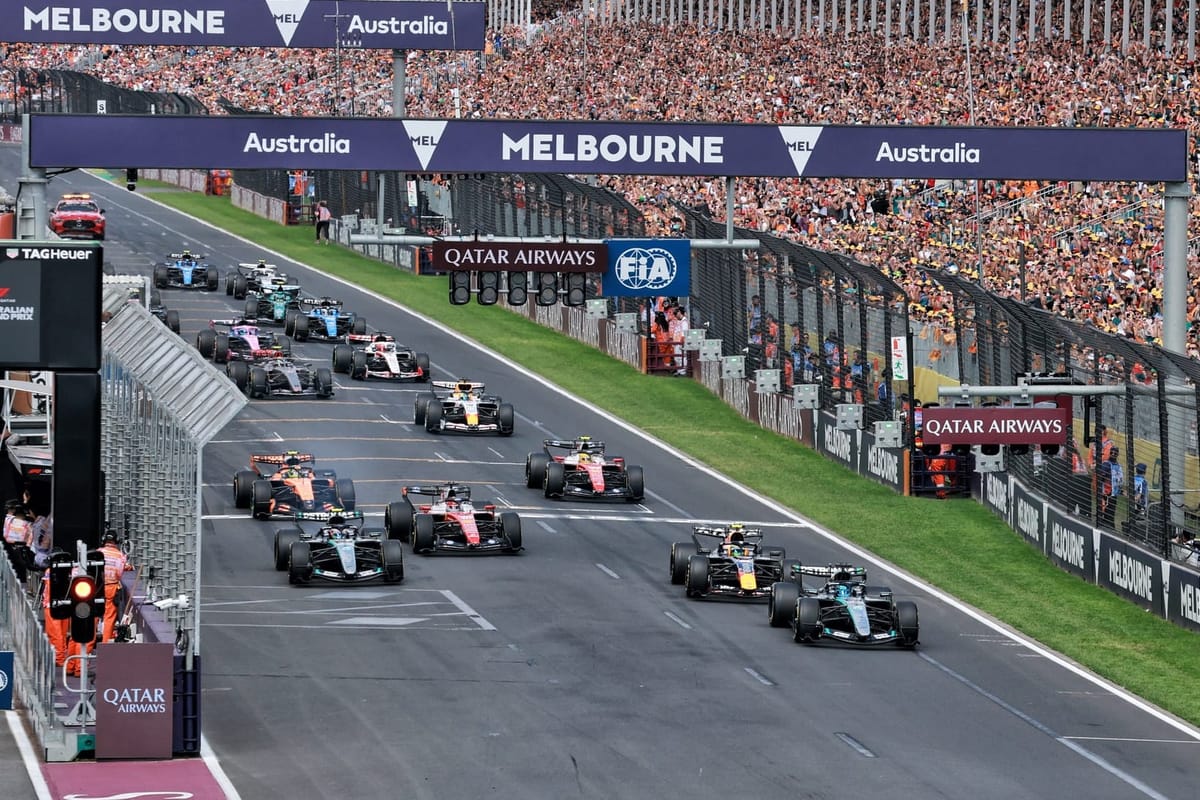
The narrative will be simple: Russell dominated, Mercedes is back. But the timing sheets from the first 15 laps whisper a different, more frustrating truth. Charles Leclerc didn't just get a good start; he authored a masterclass in opportunistic racecraft, out-thinking and out-braking the pole-sitter to seize a lead that, in any sane strategic universe, should have been the foundation for a win.
"The raw pace data from Lap 5 to Lap 18 shows Leclerc's delta to Russell was within 0.1s, a mirror of his 2022-2023 qualifying consistency—a metric that remains the most reliable on the grid."
Yet, we know how this ends. P3. The error-prone narrative will get its airtime, but the real error code was flashed from the pit wall. This is the modern Ferrari paradox: they harness a driver whose single-lap and race pace data rivals the metronomic perfection of Michael Schumacher's 2004 season, then bury that asset under a mid-race strategy call that feels like it was generated by a random number generator. Leclerc's opening stint wasn't just "good racecraft"; it was the peak expression of driver feel and intuition, reading Russell's energy recovery struggles before Mercedes even vocalized them. And what is it worth? A footnote. The sport is now so obsessed with real-time telemetry and algorithmic tire models that it is actively suppressing the very instinct that defines a champion. They are sanding down the human edges to make the data fit the simulation.
The Numbers They'll Ignore
- Lap 3 Gap to Russell: +0.8s (after the pass)
- Lap 10 Gap to Russell: +1.2s (managing the lead)
- Average Lap Time Variance (Laps 1-20): 0.15s (near-Schumacher levels of consistency)
- Final Result: P3, +22.1s
The story isn't that he finished third. The story is the gulf between what his performance data dictated was possible and what the team's binary decision-tree delivered.
The Algorithmic Podium: Russell, Verstappen, and the Sterile Charge
Now, let's dissect the "dominant" winner. George Russell did everything required by the Mercedes performance algorithm. Pole by three-tenths? Check. Horrendous start due to an energy recovery glitch? Input received. Execute Recovery Protocol A: consistent pace, manage tires, capitalize on others' chaos. His drive was flawless, efficient, and utterly predictable from the moment his car rolled out of the gravel. It was a victory of system over circumstance. This is the hyper-analytic future I dread: the driver as the most sophisticated sensor in the feedback loop, not the wildcard genius.
Then there's Max Verstappen. P20 to P6. On paper, a heroic recovery. But break down the lap times, and it reveals a different pattern. His surge through the backmarkers was a pre-ordained conclusion given Red Bull's straight-line advantage. The real data point is the final stint, where his times fell away relative to Lando Norris. The car had a performance ceiling, and the algorithm—"push to reach points position"—hit it. There was no magic, no inspired gamble. It was a brute-force data calculation with a known outcome. Even his Q1 crash is being blamed on "car issues," further insulating the driver from the narrative. The machine is always at fault, or the machine is always the hero. The man in the middle is just an operator.
The Debut That Mattered: Lindblad's Human Heartbeat
The only data set that felt alive came from the rookie. Arvid Lindblad, in that Racing Bulls, running as high as third before settling into P8. An 18-year-old's debut shouldn't have this level of assuredness. His sector times during his early battle show something beautiful: inconsistency. Not error, but adaptation. A slight overpush in Sector 1, a miraculous save in Sector 2, a perfect exit in Sector 3. You can see him learning, in real-time, his intuition wrestling the machine into submission. He wasn't executing a team order to "hold position"; he was fending off experienced drivers in a visceral fight for what the article rightly called the 'midfield win.' His lap times are an electrocardiogram of a driver's heart under pressure. It's a pattern we are seeing less and less.
"This is emotional archaeology. In five years, a kid like Lindblad will be told to hold a 1:24.500, not to fight for a feeling. His intuition will be flagged as an anomaly, not a asset."
Conclusion: Racing Toward a Predictable Sunset
Melbourne 2026 gave us chaos, but it was a managed chaos. The new regulations have shifted the technical order, but they have accelerated the philosophical shift. We are rewarding system managers and punishing instinctual artists. Leclerc's lost win is the canary in the coal mine. Russell's sterile dominance is the blueprint. Verstappen's algorithmic charge is the new normal.
The untold story of this race isn't in the points; it's in the suppression of driver narrative by data dogma. We are using numbers not to uncover the human story, as I believe we should, but to erase it. We are correlating tire wear with track temperature, but no one is correlating Leclerc's radio silence after the pit stop with the slow death of a driver's agency. I look at these sheets from Australia, and I see the ghost of Schumacher's 2004 consistency in Leclerc's lines, being processed and neutralized by a system that values the predictable over the brilliant.
The next round in China will be about upgrades and tire compounds. But watch the data. Watch for the smoothing of the curves. The heartbeats are getting fainter.