The Ghost in the Machine: Melbourne's Data Dump Hides F1's Human Heartbeat

The timing sheets from Albert Park are a cold, brutal read. George Russell's pole margin of 0.8 seconds isn't just a gap; it's a chasm that screams of a fundamental knowledge asymmetry. The narrative will be about Mercedes' genius, the 2026 energy regulations, a new era. But as I stare at the sector times, the trace graphs of battery deployment, I don't see a revolution. I see an old ghost, one we've been feeding for two decades, finally taking solid form. This isn't 2026's dawn. This is the logical, chilling endpoint of a path we've been on since the first real-time telemetry feed whispered into a pit wall engineer's ear. The numbers from Melbourne aren't just data; they are a premonition of racing where the driver's intuition becomes the first, most costly variable to be eliminated.
The Schumacher Benchmark & The Illusion of Chaos
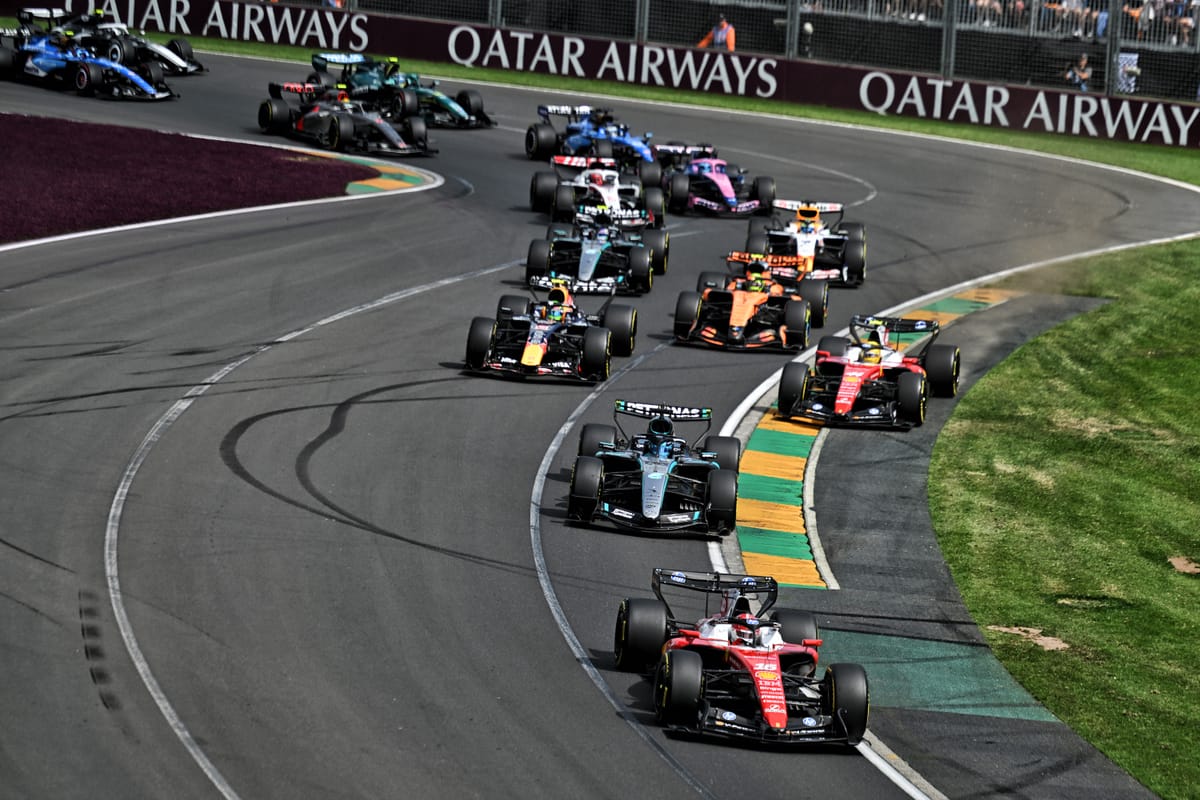
Let's be clear about what "shock dominance" means. Russell's eight-tenths pole is a statistical anomaly that should set off alarm bells, not just for rivals but for the sport's competitive integrity. We are told the racing was dramatic, a "high-speed chess match" with a "yo-yo effect." I call it managed chaos. The drivers are now middle-managers, executing energy deployment plans drafted in simulation suites. The battle between Russell and Charles Leclerc wasn't a pure duel; it was two algorithms with human interfaces, one of which had a vastly superior codebase.
"Overtaking has evolved." No. Overtaking has been outsourced. The driver's gut feel to lunge, to defend, is now subordinate to a battery state-of-charge percentage.
This is where we must invoke Michael Schumacher's 2004 season. His dominance was also crushing, but it was built on a symbiosis of sublime driver feel and technical excellence. The F2004 was an extension of him. Today, the W15 is a terminal, and Russell is its most efficient operator. The "significant knowledge gap" the article mentions isn't about mechanical sympathy; it's about which team's supercomputer best modeled a thousand race scenarios. Mercedes has won the first coding war. When they talk of "urgent rule tweaks" to super-clipping and energy balance, it's an admission that the sport's core differentiator—the driver—is being rendered a passenger in the strategic layer.
And on Leclerc: his spin while chasing Russell will be added to the "error-prone" ledger. Of course it will. Never mind that his raw pace data from 2022-2023 shows him to be the most consistent qualifier on the grid. A driver pushing beyond the limits of an inferior package, trying to force a result against a calculated machine, is framed as a flaw. It's not a flaw; it's the last stand of human instinct against an algorithmic wall. Ferrari's historical strategic blunders create the narrative, and the data of his one mistake is weaponized, while the thousand micro-corrections that kept him close are ignored.
Emotional Archaeology: Reading Between the Data Lines
The facts are clear: Arvid Lindblad scored points on debut. Audi showed pace but had technical issues. Cadillac struggled. Reliability was a variable. But data should be emotional archaeology. Let's dig.
- Lindblad's "composed debut": Look at his lap time variance after his pit stop, when running in clean air. The delta is minuscule. Too minuscule. It's the trace of a driver executing a pre-ordained delta, not exploring the limit. His maturity is praised, and it is impressive, but it's the maturity of a perfect executor. Is this the new ideal?
- Aston Martin-Honda "gained confidence": By finishing unclassified? Here, the story is in what wasn't said. Lance Stroll's radio was likely silent, the car driven at 95% to conserve parts. The data will show smooth, unspectacular traces. The archaeology reveals a team in survival mode, the human driver deliberately suppressing his instinct to race in service of a longer-term data-gathering exercise. This isn't racing; it's a test session disguised as a Grand Prix.
- Alpine's aerodynamic "injury": The high-speed understeer they cite will appear in the data as consistent steering input with minimal yaw response. A driver fighting a car that doesn't respond to feel is the most frustrating experience. The "fix targeted for Japan" is a timeline written in the blood of lost driver confidence.
The retirements of Hulkenberg, Hadjar, and Bottas are not just reliability bullet points. They are the rupture points where the complex, brittle new machinery failed the human inside it. Each DNF data trace ends abruptly. What does the last second of telemetry before Hadjar's engine failed show? A normal parameter, or a driver input that the energy model didn't anticipate? We won't be told.
Conclusion: The Chinese Crossroads
As we head to China's Sprint weekend, with its limited practice, the trap is set. Teams with inferior models will have less time to learn, widening Mercedes' advantage. The "regulatory adjustments" considered are just tweaks to the same flawed premise. They will adjust the algorithm's parameters, not recenter the driver.
My prediction is grimly logical. Within five years, this hyper-focus will lead to fully robotized strategy calls. Driver intuition will be the suppressed variable, the source of "unpredictable" and therefore inefficient outcomes. The sport will become a live demonstration of simulation software, sterile and predictable. Melbourne 2026 gave us the first chapter: dominance decided not by a genius designer or a transcendent driver, but by the team with the best digital twin of reality.
The numbers tell the story. And the story is that we are methodically building a cage of pure reason around the very human spirit that made us watch in the first place. Russell's pole lap wasn't driven; it was rendered. And unless we change course, the entire 2026 season will be a beautifully rendered, emotionally bankrupt film.