Aston Martin's 2026 pre-season plagued by Honda PU reliability issues
Aston Martin's 2026 pre-season testing has been hampered by reliability issues with its new Honda power unit, leading to limited running and urgent cooling modifications on the aerodynamically tight AMR26. The team lost most of the first Bahrain test day to a PU change, underscoring the challenge of balancing extreme packaging with engine cooling.
Aston Martin's crucial 2026 pre-season testing program has been severely disrupted by recurring reliability problems with its new Honda power unit, forcing the team to sacrifice valuable track time for urgent technical fixes. After a troubled shakedown in Barcelona, the team's first day in Bahrain was cut short by a PU issue that required a full replacement, leaving Lance Stroll with only 36 laps and highlighting a concerning start for the ambitious Silverstone squad.
Why it matters:
For a team with stated championship ambitions, losing critical pre-season testing mileage to reliability gremlins is a significant setback. These sessions are vital for correlating simulation data, understanding the new car's behavior, and building driver confidence. With Honda's 2026 power unit already rumored to be behind schedule, these public failures put immense early pressure on both the engine supplier and the Aston Martin chassis team to find robust solutions before the season opener.
The details:
- The team's Bahrain running was compromised when engineers detected anomalies in the Honda power unit's data, leading to a lengthy garage stay for the AMR26 and a full PU change in the afternoon.
- Even before the failure, Aston Martin was running a deliberately "limited" program, with Stroll not exceeding 300 km/h on the main straight and the engine kept below 11,000 RPM to reduce stress during data gathering.
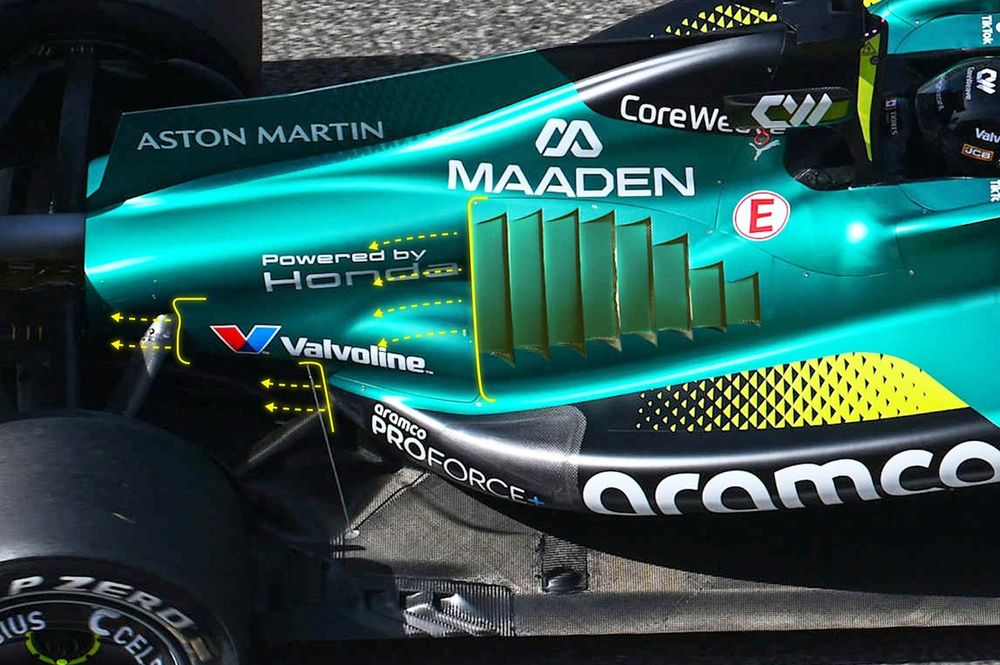
- Extreme Packaging Demands Cooling: The AMR26 features very tight bodywork packaging, with slim sidepods housing the radiators and a tapered engine cover. This aggressive aerodynamic philosophy appears to be creating cooling challenges for the Honda unit.
- On-the-Fly Modifications: To address overheating, the team opened additional cooling vents or "gills" on the engine cover during the first day—a clear compromise sacrificing aerodynamic efficiency for reliability.
- Inspired Solutions: The car also features other cooling solutions, including an opening at the rear of the sidepods reminiscent of concepts seen on the Red Bull RB20, indicating the team is exploring every avenue to manage heat.
What's next:
The focus for the remaining test days is squarely on mileage and reliability. Fernando Alonso took over driving duties for the second day, managing 55 laps—a more respectable tally—but the ultimate pace remains unknown as the team prioritizes system checks over performance runs.
- The true performance of both the Honda power unit and the aerodynamically extreme AMR26 chassis will remain a mystery until these cooling and reliability issues are fully resolved.
- This rocky start forces Aston Martin into a reactive development phase before the first race, needing to ensure the car is both fast and durable enough to convert its ambitious design into points.
Don't miss the next lap
Get the deep dives and technical analysis from the world of F1 delivered to your inbox twice a week.
Zero spam. Only high-octane analysis. Unsubscribe anytime.
Join the inner circle
Get the deep dives and technical analysis from the world of F1 delivered to your inbox twice a week.
Zero spam. Only high-octane analysis. Unsubscribe anytime.
Continue Reading
View More News