Audi reveals radical 2026 F1 car updates in Bahrain testing
Audi has unveiled a major aerodynamic update to its 2026 F1 car in Bahrain testing, featuring a radical new sidepod design and revised front wing. The changes represent a significant shift in philosophy as the team explores the new active aero regulations, with technical details analyzed by Gary Anderson. The car's performance in testing will now be closely watched to see if its bold design translates to on-track speed.
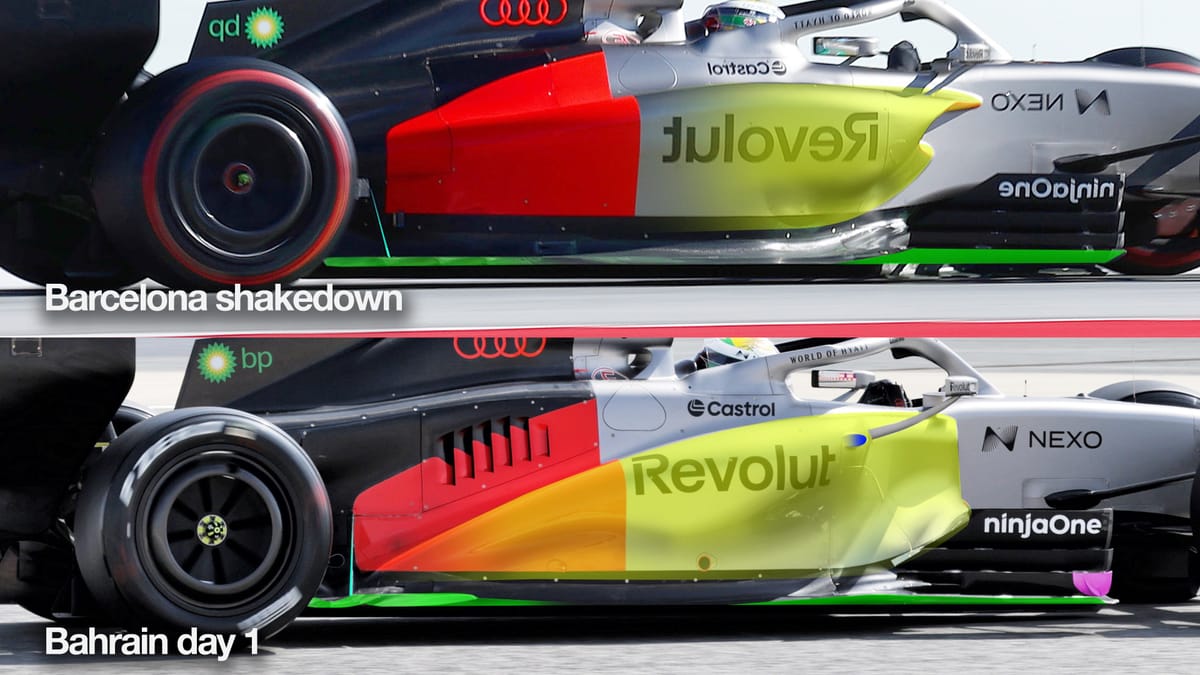
Audi has debuted a significantly updated version of its 2026 Formula 1 car in Bahrain, featuring a dramatic sidepod redesign and revised front wing, marking the first major visible development since its initial shakedown. The changes signal a bold and divergent aerodynamic philosophy as teams begin to explore the new regulations, with technical expert Gary Anderson providing a detailed breakdown of the potential performance implications.
Why it matters:
As the first team to run its 2026 car on track, Audi is now the first to show a substantial development step, offering an early glimpse into how teams are interpreting the new active aerodynamic rules. This aggressive update package underscores Audi's serious commitment to making a competitive impact upon its full works entry and sets a benchmark for the rate of development expected in this new era.
The details:
- Front Wing Evolution: The Bahrain-spec front wing features a new small turning vane on the endplate and a reshaped rear element to increase 'outwash,' directing turbulent air away from the car. The design also suggests a novel two-flap activation system for the straight-line DRS mode, differing from the approach of rivals like Mercedes.
- Sidepod Revolution: The most visually striking change is a complete overhaul of the sidepod design. Abandoning its initial 'Coke bottle' shape, Audi has adopted a swept-down top surface, reminiscent of older Mercedes concepts, aimed at improving airflow to the rear of the car and reducing detrimental effects on the underfloor.
- Bargeboard Function: The 2026 bargeboards are regulated to create 'inwash' to manage the front tire wake for the car itself. Audi's design includes horizontal slot gaps to manage the low-pressure area behind the boards, a clever detail to mitigate a regulation-imposed challenge.
- Packaging & Detail: The update showcases extremely tight packaging, with the side impact structure neatly enclosed and intricate mirror mounts, highlighting the advanced engineering level of modern F1 cars.
What's next:
While the new design is visually distinct and theoretically sound, its true effectiveness will only be revealed under competitive conditions. The stopwatch in Bahrain testing and, more importantly, the early races will determine if this radical direction is a masterstroke or a misstep. All eyes will now be on how other teams respond with their own upgrade packages as the 2026 pre-season develops.
Don't miss the next lap
Get the deep dives and technical analysis from the world of F1 delivered to your inbox twice a week.
Zero spam. Only high-octane analysis. Unsubscribe anytime.
Join the inner circle
Get the deep dives and technical analysis from the world of F1 delivered to your inbox twice a week.
Zero spam. Only high-octane analysis. Unsubscribe anytime.