Colapinto Calls Himself a 'Sitting Duck' in High-Speed Bearman Crash
A dramatic 50g crash for Ollie Bearman, caused by a massive speed difference with Franco Colapinto's Alpine, has reignited safety concerns in F1. Colapinto labeled himself a "sitting duck" and called for a review of "artificial" overtaking and dangerous closing speeds, directly linking the issue to the upcoming 2026 car regulations.
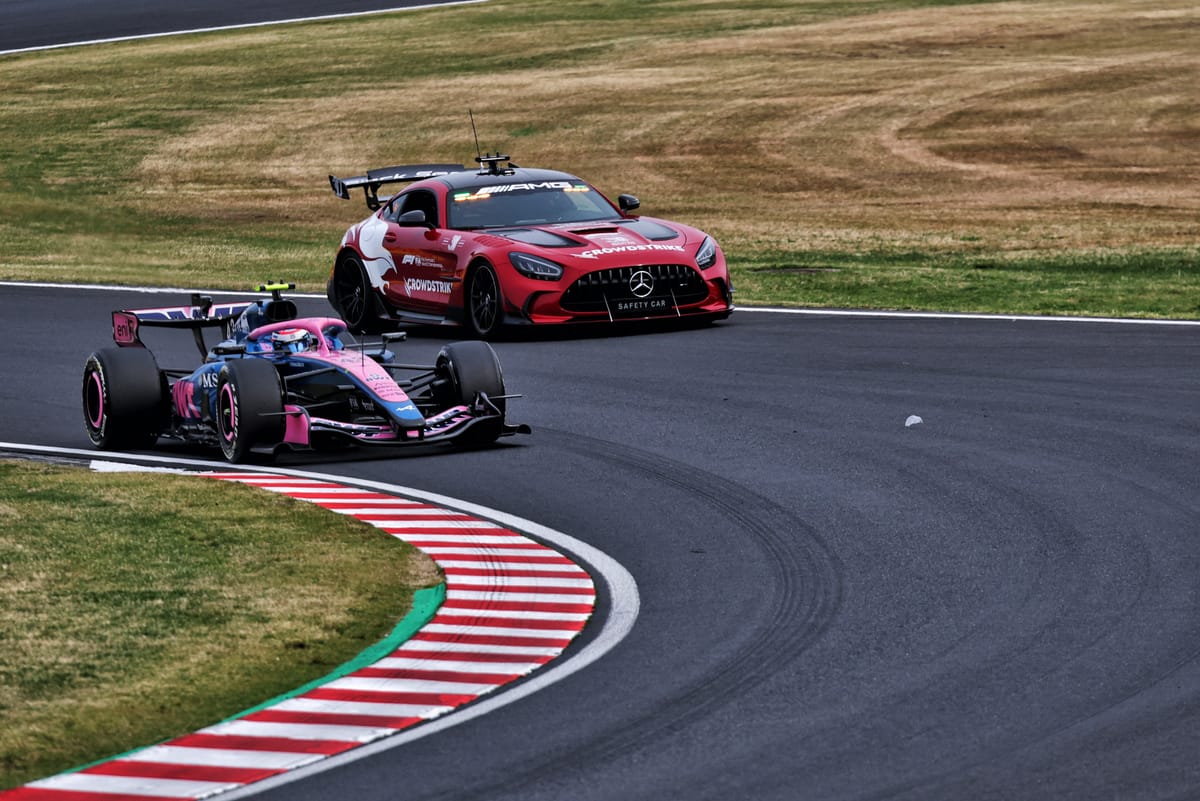
Alpine rookie Franco Colapinto described himself as a "sitting duck" after a massive speed differential led to a frightening 50g crash for Haas driver Ollie Bearman during the Japanese Grand Prix. The incident has sparked a driver-led call to review the "artificial" and potentially dangerous overtaking created by the current generation of Formula 1 cars, with concerns already looking ahead to the 2026 regulations.
Why it matters:
This high-profile crash puts a spotlight on a growing safety concern within the current F1 era: extreme speed differences between cars on different parts of their tire and fuel strategies. When one car is traveling over 50 km/h faster than another on a section of track that isn't a pure straight, it creates a closing speed scenario that drivers argue is unpredictable and inherently risky, raising urgent questions about car performance parity and racecraft safety.
The details:
- The incident occurred on Lap 22 on the approach to the Spoon corner at Suzuka. Ollie Bearman, on a much faster lap, closed on the slower Alpine of Franco Colapinto at a difference estimated at around 50 km/h.
- Bearman was forced to take evasive action, swerving onto the grass, which sent his Haas spinning backwards into the barriers in a heavy impact. He was fortunate to escape with only bruising to his knee.
- Colapinto defended his driving line, stating he did not move in reaction to Bearman and was taking a normal line through the sweeping section. He emphasized the sheer velocity gap was the root cause, making any avoidance nearly impossible for the slower car.
- Driver Reaction: Colapinto was vocal post-race, stating, "It gets really sketchy when the straights are not straight and it's turning... At some point it becomes really dangerous. I'm glad he is OK."
- Broader Complaint: Colapinto linked the incident to his criticism of current "artificial" overtaking, where cars blast past with massive straight-line speed advantages due to battery deployment (or lack thereof), making the moves feel inevitable rather than earned through braking zones.
By the numbers:
- 50g: The recorded impact force of Bearman's crash into the tire barriers.
- >50 km/h: The estimated speed advantage Bearman had over Colapinto at the moment of the incident.
- 45 km/h: Colapinto's estimate of how much quicker Bearman was through that sector compared to the Haas driver's own previous lap, suggesting full energy deployment was a key factor.
What's next:
The incident has amplified existing driver unease about the racing product and safety implications of the current power unit and aerodynamic regulations.
- Colapinto explicitly called for the FIA and Formula 1 to "review" these closing speed scenarios, especially with the next generation of cars set for introduction in 2026.
- The core debate centers on balancing overtaking opportunity with driver safety and the "authenticity" of racing battles. This crash provides a stark, real-world example that will likely fuel technical discussions among teams and regulators as the 2026 spec is finalized.
- While the 2026 rules aim to reduce car size and weight and increase reliance on electrical power, ensuring they don't exacerbate these dangerous speed differentials will be a critical challenge.
Don't miss the next lap
Get the deep dives and technical analysis from the world of F1 delivered to your inbox twice a week.
Zero spam. Only high-octane analysis. Unsubscribe anytime.
Join the inner circle
Get the deep dives and technical analysis from the world of F1 delivered to your inbox twice a week.
Zero spam. Only high-octane analysis. Unsubscribe anytime.
Continue Reading
View More News