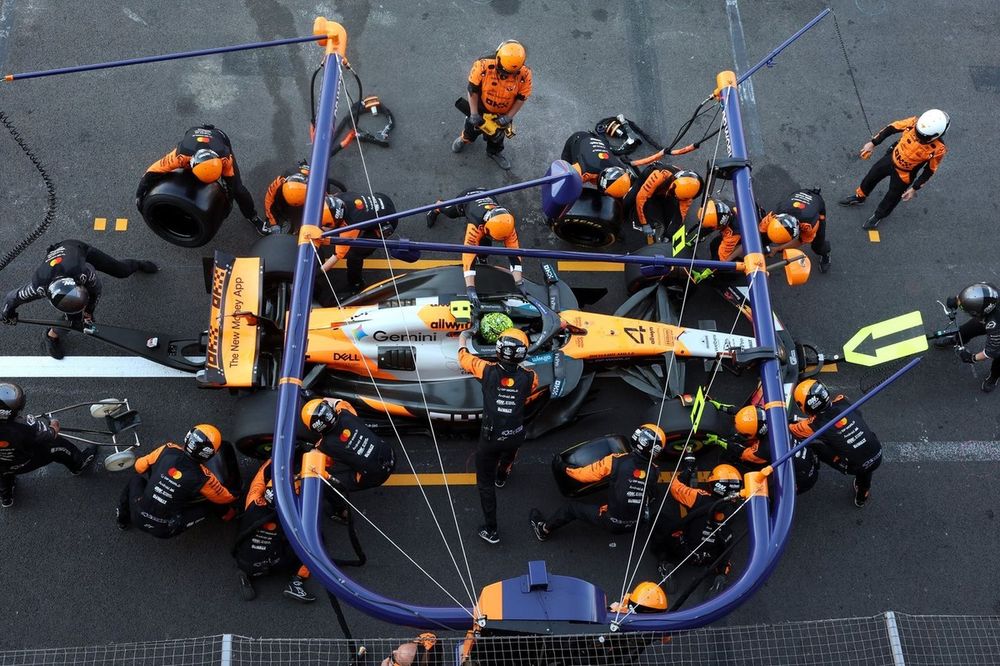
F1 Commission Debates Mandatory Two-Stop Races, No Immediate Decision
The F1 Commission met to discuss a polarizing proposal for mandatory two-stop races aimed at increasing strategic variety, but no immediate decisions were made. The concept, which faces both support for increased jeopardy and opposition over potential strategy synchronization, will continue to be debated for the 2026 season. Additionally, a new rule was introduced for 2026 mandating that at least 55% of a car's surface must be covered by livery, not bare carbon fiber, to improve visual differentiation.
A proposal to mandate two pit stops per race in Formula 1 was debated by the F1 Commission, but no immediate changes were agreed upon. The idea, aimed at increasing strategic variety, will continue to be discussed for the 2026 season.
Why it matters:
After a series of races with limited tactical variations, the debate over mandatory two-stop races highlights F1's ongoing struggle to enhance on-track excitement and unpredictability. While proponents believe it will introduce more jeopardy, opponents fear it could lead to a narrow, synchronized strategy across all teams, potentially diminishing strategic intrigue rather than improving it.
The details:
- The F1 Commission, chaired by FIA single-seater director Nikolas Tombazis, met in London to discuss various proposals, including mandatory two-stop races.
- The concept gained traction recently due to a lack of tactical diversity in several races, despite Pirelli's efforts to introduce a 'step' between harder tire compounds at events like the United States and Mexican Grands Prix.
- Arguments for: Supporters believe it will create more race jeopardy and introduce tactical variety.
- Arguments against: Opponents, including Williams team principal James Vowles (a former Mercedes head of strategy), fear that all teams would converge on nearly identical strategies, thereby eliminating true variation.
- McLaren boss Andrea Stella also expressed caution, noting that current one-stop vs. two-stop scenarios, where a two-stopper chases down a one-stopper, would disappear.
- Pirelli's preference is not to force two stops, but rather to make the strategic difference between one and two stops less clear-cut. Their recent 'step' in tire compounds aimed to make one-stop races on hard tires slower, but teams still managed one-stop races without using the hard compound.
- FIA Statement: The F1 Commission discussed mandatory two pit stops, adjustments to tire specifications, tire-life limits, and the use of three compounds. No changes were agreed upon, but discussions will continue for the 2026 season.
Between the lines:
Beyond pit stop strategies, another significant outcome from the meeting was a new regulation regarding car liveries for 2026. The FIA agreed that a minimum of 55% of the car's surface area (from side and above views) must be covered by painted or stickered liveries, rather than bare carbon fiber. This measure aims to increase visual differentiation between cars on TV, addressing concerns from the commercial rights holder about teams running minimalist paint schemes to save weight, which made cars look too similar.
What's next:
The discussions around mandatory two-stop races are far from over, with further talks planned for the 2026 season. The F1 Commission and teams will continue to analyze simulations and feedback to find a solution that genuinely enhances strategic variety without inadvertently simplifying it. Meanwhile, the new livery rule for 2026 will ensure that cars maintain a distinct visual identity, potentially impacting car design and weight considerations for teams in the coming years.