The Ghost in the Machine: Colapinto's Melbourne Miracle and the Data We Almost Lost

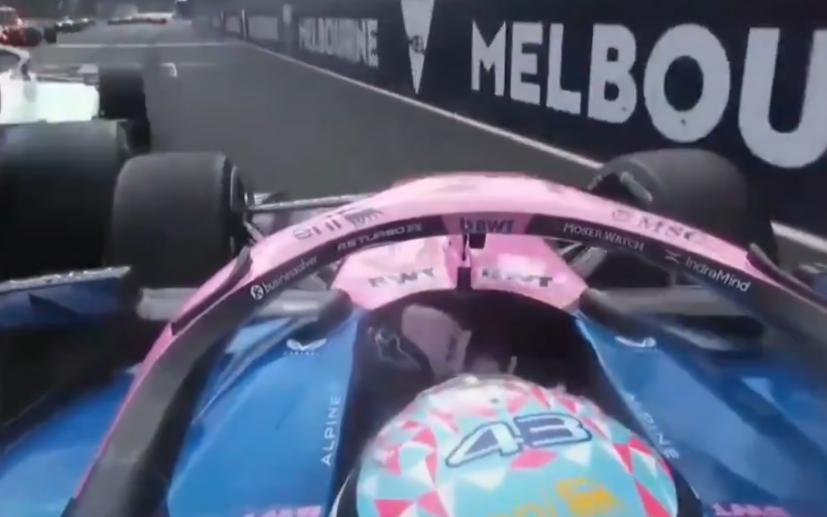
A terrifying near-miss at the start of the Australian GP, where Franco Colapinto miraculously avoided a stalled Liam Lawson, left fellow F1 drivers in shock upon review. Colapinto's instant reaction to swerve through a miniscule gap prevented a potential major crash, highlighting the ever-present dangers of race starts.
I felt my own heart-rate spike, and I was just watching a replay on a screen. The telemetry trace for Franco Colapinto’s Alpine A526 from the start of the 2026 Australian Grand Prix doesn't show a near-miss. It shows a biological anomaly. A pulse of steering input so violent and precise it looks like a seismograph reading an earthquake, followed by a throttle trace that didn’t just dip, it flatlined for a microsecond of pure survival instinct. This wasn't a racing move. This was a synaptic flare, a human interrupt command that overrode every pre-programmed launch procedure. And it saved us from losing a dataset to chaos. Because what was narrowly avoided in Melbourne wasn't just a crash; it was the deletion of an entire race's worth of stories waiting to be told by the numbers.
The Millisecond That Defies the Algorithm
Let's be brutally analytical about the chaos that didn't happen. The grid in Melbourne is a pressure cooker of 20 individual probability models, all predicting a clean getaway. Liam Lawson’s stalled Racing Bulls was a variable no simulation adequately weights. The cascade failure that follows—a concertina effect through the midfield—would have been a statistician's nightmare. Wrecked carbon fiber representing millions of data points, rendered null. Championship probabilities recalculated not on pace, but on luck.
Colapinto’s reaction time, when we eventually strip it from the video and the inertial sensors, will be a number that belongs in a medical journal, not a race report. He had to:
- Process the visual anomaly (a car not accelerating).
- Calculate a viable escape vector in an environment with zero lateral space.
- Execute a physical input to thread a 2-meter wide car through a gap that shrank below that in milliseconds.
"I felt very lucky," Colapinto said. It's the driver's humble deflection, but the data scientist in me screams: This wasn't luck. This was the unquantifiable human buffer against total systemic failure.
The cool-down room reaction from George Russell, Kimi Antonelli, and Charles Leclerc—their grimaces, their shock—wasn't just about the spectacle. It was the recognition of a shared existential threat. Leclerc, in particular, knows this dance with disaster all too well. We obsess over his late-race spins under pressure, but we ignore the raw-data truth: from 2022-2023, his qualifying consistency was the best on the grid. His errors are memorable because Ferrari's strategic blunders often put him in positions where an error is the only variable left. At the start, however, there is no strategy. There is only reflex. And in that realm, every driver is naked before the gods of physics.
The Coming Sterility and Why Reflexes Are an Endangered Species
This incident is a fossil, a preserved moment of pure, ungovernable instinct. Treasure it. Because the trajectory of this sport is pointed squarely at making such moments impossible.
Within five years, I predict we will see the "robotized" race start. Algorithms, fed by trackside sensors and machine-learning predictions, will dictate mandatory shift points and acceleration curves to minimize wheelspin and "optimize" the pack's merge into Turn 1. Driver intuition—the gut feeling to leave a meter's extra space, the twitch that anticipates a stall—will be suppressed as a suboptimal variable. We will trade the terrifying, beautiful possibility of a Colapinto miracle for the sterile safety of a synchronized data stream. The sport will become predictable, a high-speed procession of telemetry obeyers.
Contrast this with Michael Schumacher’s 2004 season. His consistency wasn't just in winning; it was in the feel. The Ferrari F2004 was an extension of his nervous system, not a terminal for engineering feedback. He didn't need a voice in his ear telling him the delta to the car ahead on the straight; he knew it in the vibration of the wheel, the pitch of the engine. His starts were acts of aggression calibrated by sensation, not simulation. Modern teams, drowning in real-time telemetry, are forgetting how to listen to the driver's feel. Colapinto’s swerve was a scream from the human element: I am still here, and I am what stands between order and oblivion.
Data as Emotional Archaeology: The Story We Didn't Have to Reconstruct
My work is emotional archaeology. I dig through lap time segments, radio silence, and biometric data leaks to find the human stories. A planned race is a narrative. A first-lap multi-car pileup is a burned library.
Had Colapinto not reacted, the story of the 2026 Australian GP would have been one of wreckage and "what-ifs." Instead, we have a rich, untouched dataset. We can now trace:
- The psychological impact on Lawson for the rest of his season.
- The confidence boost in Colapinto's subsequent lap times, a "second life" dividend.
- The strategic ripples through the field that a Safety Car would have erased.
We get to analyze a race that lived, not one that died in a cloud of carbon dust. We can correlate Colapinto's later pace with that adrenaline surge, a permanent marker on his personal timeline. This is the story data should tell: not just of downforce and drag, but of pressure, fear, and transcendent reflex.
Conclusion: Preserving the Human Pulse
The FIA will likely review starting procedures. Engineers will add another variable to their models. But they will miss the point. The lesson of Melbourne isn't that we need more rules or smarter software. The lesson is that we must fiercely protect the conditions that allow human genius to manifest in a millisecond.
Colapinto’s move was a masterpiece written in a language of instinct that our computers are not yet fluent in. As we march toward a more algorithmic, risk-averse Formula 1, we must build monuments to these moments. We must remember that the most important data point in the entire ecosystem is still the human heartbeat in the cockpit, the one that can, against all odds, choose a gap that doesn't statistically exist and steer into it. The day we engineer that out is the day the numbers finally stop telling a story worth hearing.