F1 teams already finding ways around 2026's new 'inwash' aerodynamic rules
Analysis of the 2026 F1 cars reveals teams are already designing ways to counteract the new 'inwashing' aerodynamic rules intended to improve racing. Top teams like McLaren, Mercedes, and Red Bull have adopted radically different approaches to recover performance, leading to significant design divergence on the grid as they seek any early advantage.
Formula 1's 2026 cars reveal a clear, immediate trend: teams are aggressively working to subvert the new aerodynamic regulations designed to promote closer racing. The FIA's key 'inwashing' floor boards aim to limit performance-harming outwash for following cars, but every top team's launch-spec design shows a different approach to recovering that lost performance, leading to significant visual and technical divergence on the grid.
Why it matters:
The regulatory intent is to create a less turbulent wake, improving the racing spectacle. However, history shows that teams will always seek a performance advantage, often at the expense of the rulemakers' goals. The early design splits indicate where each team believes the biggest performance gains can be found, setting the stage for a critical development race that will define the early competitive order of the new era.
The details:
The central challenge is managing airflow from the front wheels. The mandated inwash boards pull turbulent air towards the car's center, hurting underfloor performance. Teams are using every other part of the car to push that air back out (outwash).
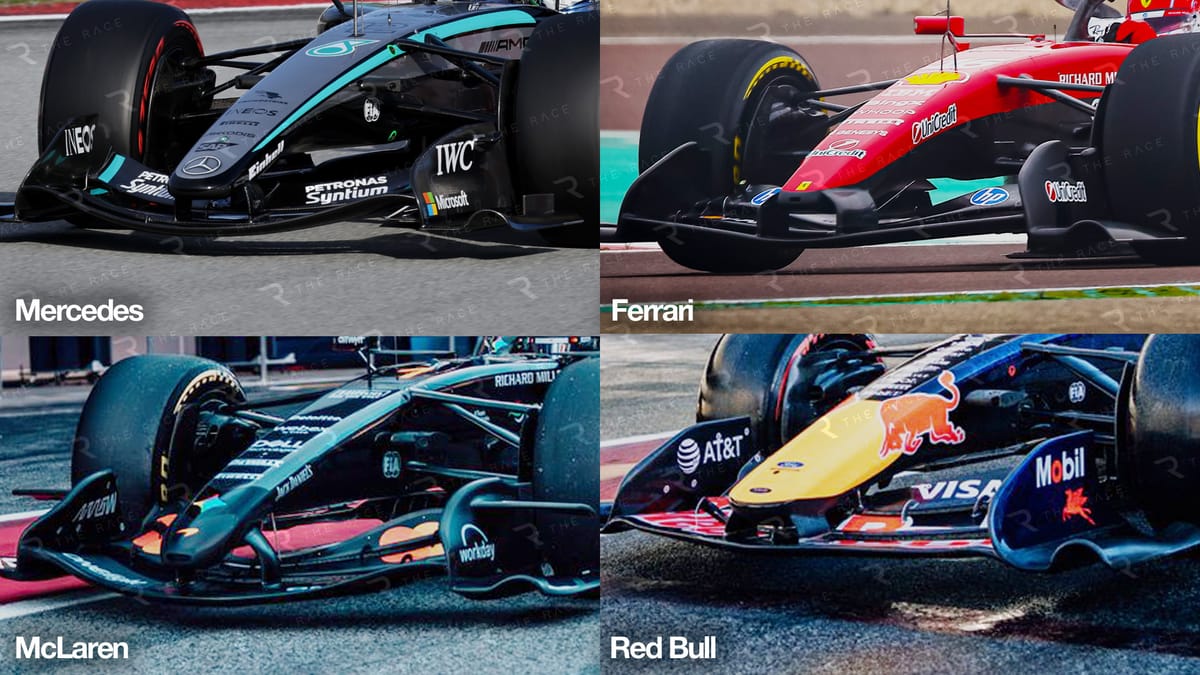
- McLaren employs an aggressive front wing and endplate design to create spinning vortices that aid outwash. It uses a unique, large triangular upper floor board element to push airflow upwards and away from the underfloor.
- Mercedes has opted for a high nose and a massive sidepod undercut running the car's full length, using low pressure to pull airflow outward. It mounts its nose to the middle of the front wing for maximum under-nose space.
- Red Bull features startlingly small sidepods and a wide nose. Its design focuses on manipulating air pressure in a 3D triangle beneath its shallow 'tube' pod to pull flow away from the floor boards, with much of its cooling packaged high around the car's centerline.
- Aston Martin combines a wide nose with an enormous exposed floor area ahead of the rear tyre. Its most extreme feature is a super-high rear suspension mount that clears wide paths for airflow and may provide a rear wing benefit.
- Ferrari presents a more conventional, less extreme look with a low nose, large front wing, and full-length sidepod undercut, suggesting a focus on radiator cooling placed low in the car.
A telling detail is the 'mousehole' in the diffuser wall seen on Mercedes and Red Bull, a feature used to keep airflow attached—a hint that the new rules have indeed reduced energy flow to the underfloor generically.
What's next:
These are just launch-spec cars, with major updates expected before the first race in Bahrain and throughout the season. The development race to optimize these divergent concepts will be fierce. The team that best balances the trade-off between creating outwash for its own performance and managing the car's wake for the benefit of others (a consideration for qualifying vs. race trim) may gain a crucial early advantage. This technical divergence is normal for a new rule set, but it promises a fascinating and unpredictable start to the 2026 season.
Don't miss the next lap
Get the deep dives and technical analysis from the world of F1 delivered to your inbox twice a week.
Zero spam. Only high-octane analysis. Unsubscribe anytime.
Join the inner circle
Get the deep dives and technical analysis from the world of F1 delivered to your inbox twice a week.
Zero spam. Only high-octane analysis. Unsubscribe anytime.
Continue Reading
View More News