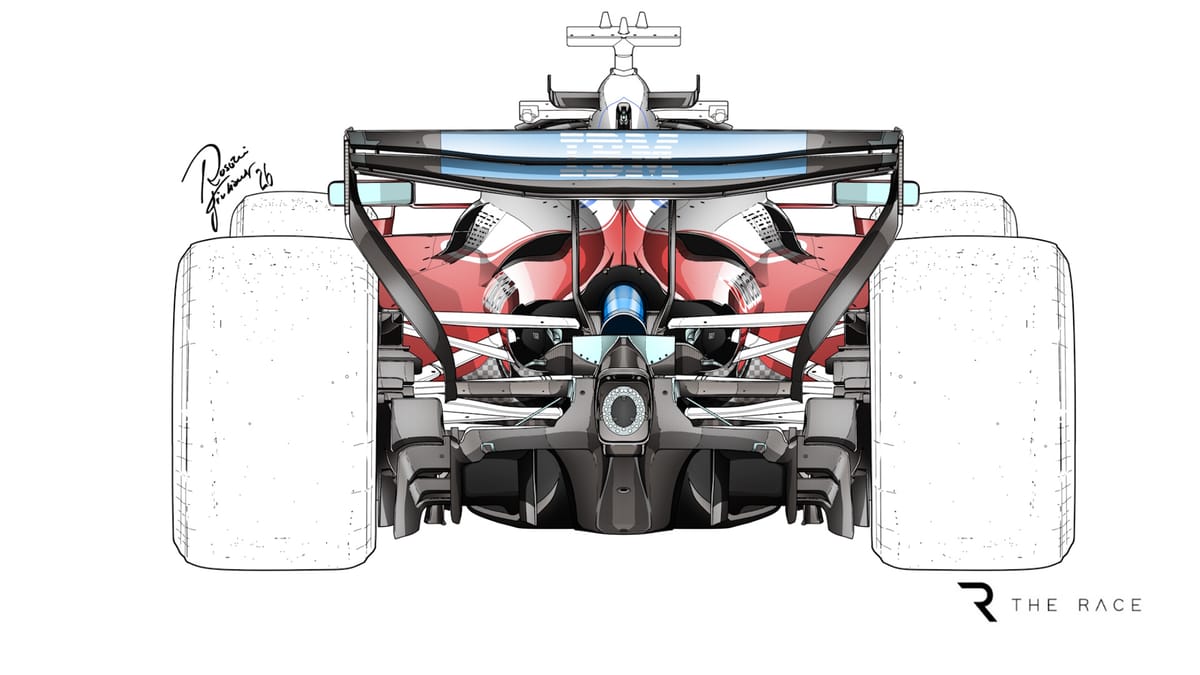
Ferrari's 2026 exhaust wing is a clever innovation rivals can't easily copy
Ferrari's innovative 2026 exhaust wing, designed to clean up turbulent gases for more downforce, is uniquely tied to its gearbox placement. This makes the concept difficult for most rivals to copy quickly, potentially giving the team a protected performance advantage at the start of the new F1 season.
Ferrari unveiled a clever aerodynamic innovation—a small wing surrounding the hot exhaust outlet—during pre-season testing, capitalizing on a specific gearbox packaging choice that makes it difficult for rivals to replicate quickly. While its more visually striking 'upside-down' rear wing grabbed headlines, this exhaust solution represents a deeper technical play that exploits regulatory gray areas for a tangible performance gain.
Why it matters:
In Formula 1's tight development race, finding a performance advantage that is protected by a team's unique car architecture is invaluable. Ferrari's exhaust wing is not just a simple bolt-on part; it's the result of a holistic design choice made around the gearbox and crash structure. This means competing teams constrained by different initial packaging decisions cannot simply copy the wing without significant, time-consuming redesigns of their car's core layout, potentially giving Ferrari a protected advantage in the early season.
The Details:
- The wing is integrated with the rear crash structure and diffuser walls, designed primarily to clean up turbulent, hot exhaust gases exiting the diffuser, thereby improving its efficiency.
- Its legality and size depended on Ferrari pushing the rear 'tail volume' box to its rearmost possible position, a move dictated by the placement of their gearbox differential.
- A Regulatory Niche: Ferrari exploited a small allowance in the technical regulations (Article 9.5.1) that permits the differential to be positioned up to 60mm forward or rearward relative to the wheel axis. Ferrari opted for the most rearward setting.
- Packaging Challenge: This rearward differential placement required a very narrow gearbox casing to avoid compromising the central section of the diffuser, a complex reliability challenge for a team traditionally more conservative in gearbox design.
- Synergy with New PUs: The benefit of managing exhaust flow could be greater with the 2026 power units, as energy recovery strategies may lead to more instances of the engine staying on throttle while harvesting energy, making cleaner aerodynamic management around the exhaust a valuable trait.
What's next:
While not a 'game-changer' on the scale of historical innovations like the double diffuser, this wing could provide Ferrari with a small but consistent downforce advantage, particularly in a variety of cornering conditions. Only one other team, Haas, which uses Ferrari's transferable components including the gearbox, is in a position to potentially adopt this concept directly. For the rest of the grid, replicating it would require a fundamental review of their rear-end packaging, making it a medium-term project at best and solidifying any early competitive edge for the Scuderia.