FIA's AI Revolution Aims to End F1's Track Limits Debate
The FIA is leveraging AI and real-time data fusion to automate track limits enforcement. A new "Every Car All Turns" system uses positioning data and geofencing to monitor every car continuously, building on existing tech that cut manual reviews by 95%. The goal is to eliminate controversy with transparent, data-driven decisions.
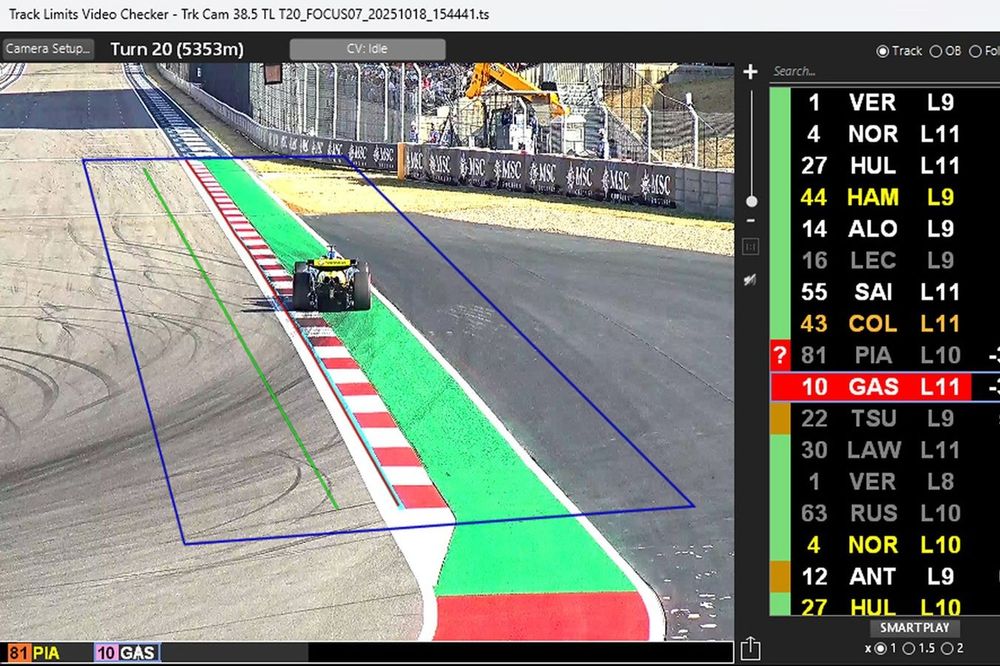
The FIA is deploying advanced AI and data systems to automate and refine track limits enforcement, aiming to eliminate the protracted controversies that have plagued Formula 1. A new computer-vision tool has already reduced human-reviewed cases by 95%, with a more comprehensive "Every Car All Turns" (ECAT) system set for future implementation to monitor car positioning in real-time across the entire circuit.
Why it matters:
Track limits have become one of F1's most persistent and time-consuming controversies, delaying race results and fueling endless debate. The sheer volume of potential infringements—over 1,000 required review at the 2023 Austrian GP alone—made a technological solution essential. Moving from a manual, camera-reliant process to an automated, data-driven one increases consistency, transparency, and speed, which is critical for the sport's integrity and fan experience.
The Details:
- Current System: The FIA, in partnership with Catapult, already uses a computer-vision-based tool integrated into its RaceWatch race management software. It analyzes camera footage against predefined reference points to detect white line crossings.
- 95% Efficiency Gain: This existing automation has slashed the number of cases requiring human steward involvement by 95%, allowing teams to be notified of potential infringements within seconds.
- 2026 Upgrades: Planned updates will allow the FIA to send video evidence of infringements directly to teams, increasing transparency. The core upgrade is the shift to the ECAT system.
- The ECAT System: This new approach uses high-performance GPUs to process data in real-time. It creates a "digital twin" of on-track action by fusing high-precision positioning data, micro-sector timing, and ideal racing line models.
- It uses geofencing (virtual zones on the track) and detects deviations from the optimal line, triggering alerts based on positioning data even without direct camera coverage.
- The system can infer an off-track excursion by analyzing if a car covers more distance in a sector, indicating a deviation from the racing line.
- Distributed Processing: The new architecture uses a centralized camera controller to distribute video processing across the network, enabling the handling of vastly more data.
What's Next:
The enhanced capabilities are being worked on throughout 2025, with elements becoming operational this year. The ultimate goal is a system that works automatically across the entire track at all times, moving from a semi-automatic to a fully automated monitoring process. While human stewards will still evaluate penalties, the FIA's data-driven approach aims to provide irrefutable evidence, potentially putting an end to the subjective debates that have long surrounded track limits in Formula 1.
Don't miss the next lap
Get the deep dives and technical analysis from the world of F1 delivered to your inbox twice a week.
Zero spam. Only high-octane analysis. Unsubscribe anytime.
Join the inner circle
Get the deep dives and technical analysis from the world of F1 delivered to your inbox twice a week.
Zero spam. Only high-octane analysis. Unsubscribe anytime.