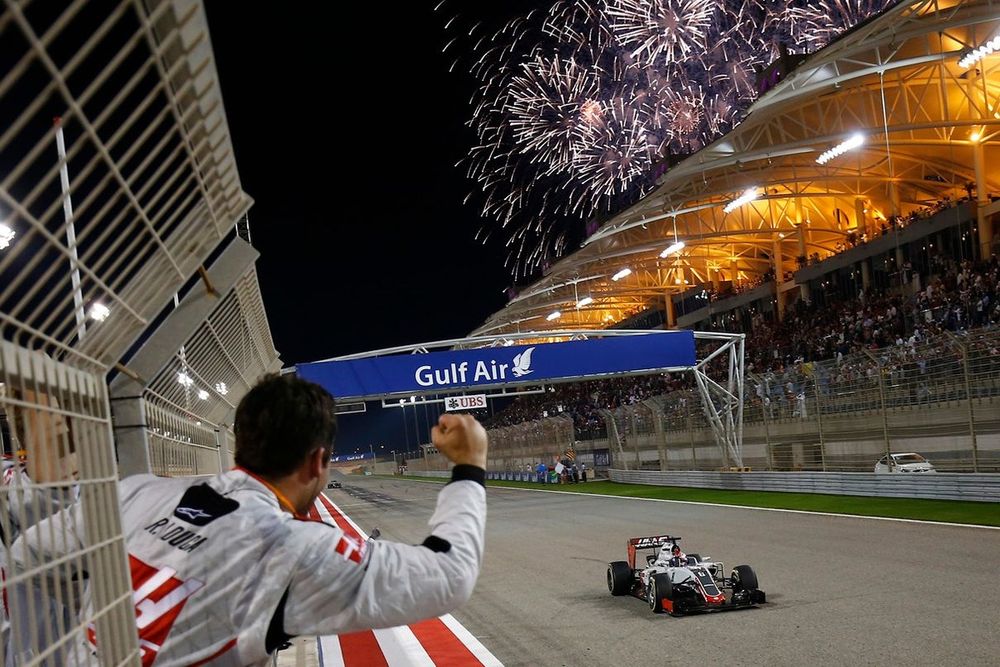
Haas's improbable 2016 debut: From chaos to points
Haas F1 Team's chaotic and exhausting preparation for its 2016 debut nearly broke the staff, but against all odds, Romain Grosjean delivered sixth and fifth-place finishes in the first two races. These results validated the team's revolutionary lean model with Ferrari and Dallara, provided a crucial morale boost, and secured its future in Formula 1.
Haas F1 Team's debut in 2016 was a story of survival, built on an unproven business model and a team pushed to its absolute limits. Against all odds, the squad not only made it to the grid but scored points in its first two races, a feat that saved morale and defined its early identity.
Why it matters:
Haas's entry broke the curse of failed F1 start-ups in the 2010s, proving a lean, collaborative model with Ferrari and Dallara could work. The team's immediate success validated a revolutionary approach and provided a crucial morale boost that likely prevented a staff exodus, securing the team's future on the grid.
The details:
- A Revolutionary Model: Team Principal Guenther Steiner devised a plan to bypass traditional start-up pitfalls by heavily leveraging Ferrari for power unit, suspension, and hydraulics, while outsourcing chassis construction to Dallara. This allowed Haas to operate as a lean racing team from day one.
- "That Was Hell": The build-up to the first car was chaotic. With neither Ferrari nor Haas experienced in such an extensive supply partnership, parts arrived last minute. Staff drove rental cars constantly between Maranello and Dallara's factory, with the car only fully assembled just before pre-season testing.
- A Team on Its Knees: The intense workload before the season led to resignations. The team arrived in Melbourne exhausted, having never completed a full live pitstop practice. Chief Race Engineer Ayao Komatsu noted, "everybody was on their knees."
- Debut Dream in Melbourne: Driver Romain Grosjean capitalized on a red flag caused by his teammate's crash to finish an astonishing sixth. The team changed his tires under the red flag, negating the need for a race pitstop. Grosjean called it "a win for us."
- Proving It Wasn't Luck in Bahrain: Two weeks later, Grosjean finished fifth on pure pace with an aggressive three-stop strategy, overtaking cars like Red Bull and Williams. The result was a massive validation of the car's performance.
The big picture:
The 2016 debut created the foundation and identity for Haas F1 Team. It demonstrated that a clever, resource-efficient model could compete in Formula 1, challenging the notion that only fully independent factories or manufacturer-backed giants could succeed. The early points were not just a bonus; they were a vital lifeline that justified the immense effort, stabilized the team, and built the confidence needed to establish itself as a permanent fixture. The story remains a defining chapter of resilience in modern F1.
Don't miss the next lap
Get the deep dives and technical analysis from the world of F1 delivered to your inbox twice a week.
Zero spam. Only high-octane analysis. Unsubscribe anytime.
Join the inner circle
Get the deep dives and technical analysis from the world of F1 delivered to your inbox twice a week.
Zero spam. Only high-octane analysis. Unsubscribe anytime.