Inside F1's Cutting-Edge Broadcast HQ in Biggin Hill
F1's Media & Technology Centre in Biggin Hill has revolutionized sports broadcasting, becoming the remote nerve center for global race coverage. By virtualizing infrastructure and centralizing operations, F1 processes vast amounts of data, delivers two distinct feeds, and significantly reduces its carbon footprint, all while maintaining minimal broadcast delays. The facility's advanced capabilities, including meticulous audio processing and robust disaster recovery protocols, underscore F1's commitment to cutting-edge technology and sustainability.
On the outskirts of London, Formula 1's Media & Technology Centre (M&TC) at Biggin Hill has become the nerve center for global race broadcasts, processing over 1.1 million data points per car and capturing every audio-visual detail for 820 million viewers worldwide. This state-of-the-art facility has redefined F1 broadcasting, shifting the primary production hub from the trackside to a remote, virtualized environment.
Why it matters:
F1's M&TC is a testament to how advanced technology and remote operations are revolutionizing sports broadcasting. By centralizing operations and virtualizing infrastructure, F1 has not only enhanced efficiency and agility but also significantly reduced its carbon footprint, aligning with its Net Zero by 2030 target. This shift allows for unprecedented control and flexibility in delivering the F1 experience to a global audience.
The Details:
- Centralized Hub: The M&TC is a production complex that manages all aspects of F1 weekend capture, including live camera feeds, team radios, virtual signage, and telemetry data for on-screen graphics.
- Data Transfer: A colossal 600 terabytes of data are transferred between the M&TC and the on-site Event Technical Centre (ETC) per event weekend, peaking at 8.5 GB/s.
- Virtualization: In a remarkable 10-week overhaul in 2021, F1's IT director Chris Roberts, in collaboration with Lenovo, virtualized and containerized the entire M&TC environment, making it more agile and responsive to growing demands.
- Two Feeds: The M&TC produces two main video feeds: the world feed for international broadcasters (over 180 territories) and content for F1 TV, a direct-to-consumer streaming service offering a vast array of F1 content.
- Minimal Delay: Despite the remote operation, the delay between on-track action and video footage reaching the M&TC is a mere 160 milliseconds for the longest-distance races like Melbourne.
- COVID-19 Impact: The pandemic accelerated a five-year plan for remote operations into just three months, forcing the separation of broadcast production into traveling and Biggin Hill-based components.
- Environmental Gains: Virtualization significantly reduces freight weight from the ETC, leading to a major reduction in carbon emissions and mitigating hardware damage risks from international travel.
Between the lines:
Dean Locke, F1's director of broadcast and media, notes a significant shift: "This place used to be called 'The Remote'. Actually, we quickly found out this wasn't the remote bit; if anything, the track is the remote bit now." This highlights the profound redefinition of broadcasting roles, with Biggin Hill now serving as the ultimate control center.
The big picture:
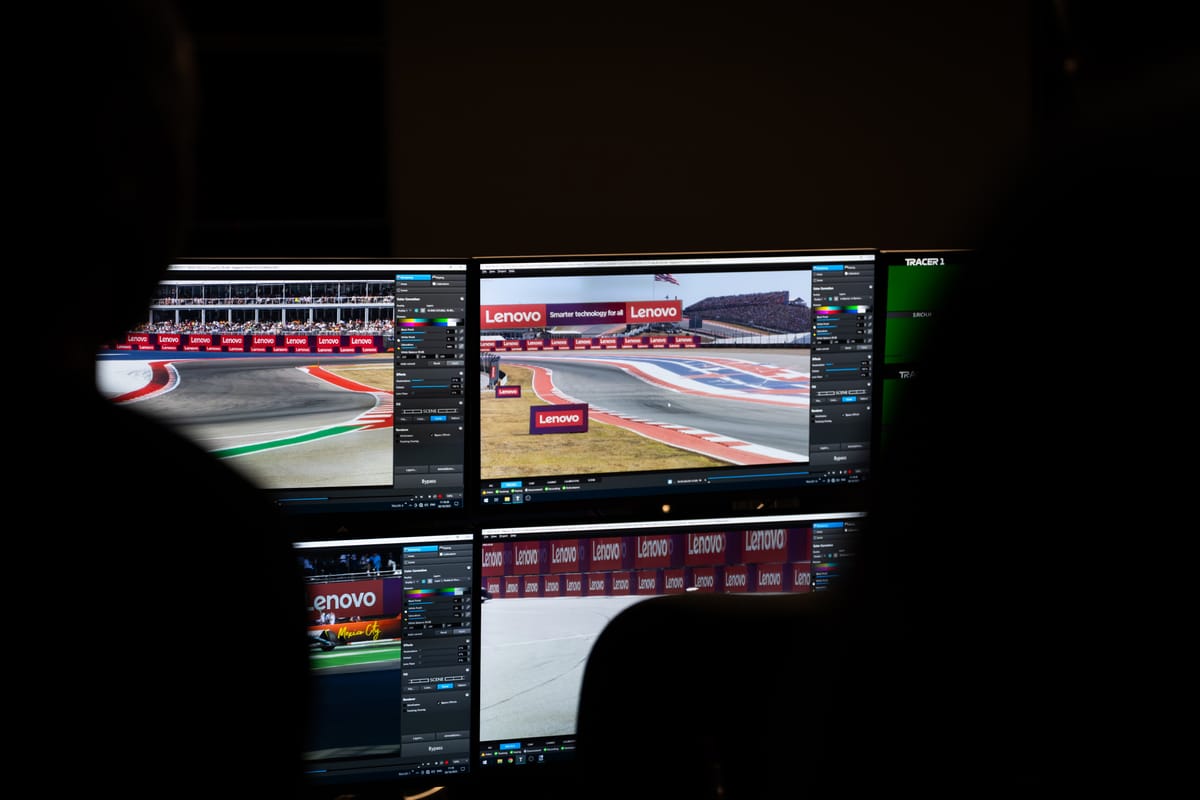
The Media Control Room at M&TC is motorsport's ultimate mission control, with screens displaying every aspect of a race. International feed director Phil Rorke oversees an average of 5,000 cuts per race weekend, weaving a compelling narrative for viewers worldwide. The operation demands extreme calm, even as noise levels can rise significantly during intense moments like race starts.
What's next:
- Disaster Recovery (DR): F1 practices DR every Thursday before a race, testing satellite-based broadcasting from the ETC to ensure minimal disruption, as seen during a rare outage at the 2025 Mexican Grand Prix caused by external infrastructure issues.
- Radio Room Evolution: An eight-person audio team meticulously filters 20 simultaneous driver radio conversations into clear, digestible clips, with a ninth member joining in 2026 to accommodate the Cadillac team's arrival.
- AI Integration: Plans are underway to implement AI tools to speed up radio transcription, further enhancing the team's already impressive turnaround times for delivering critical audio to broadcasts.
These ongoing developments solidify F1's commitment to pushing the boundaries of sports broadcasting technology and delivering an unparalleled viewing experience, all while striving for greater efficiency and sustainability.