The Ghost in the Machine: How a 'Sub-Optimal' Start Proves F1 is Erasing Its Own Pulse

Charles Leclerc says his race-winning start in Australia was far from perfect, revealing a widespread battery issue made the launch chaotic. He gained the lead simply because his Ferrari had the 'least issues' compared to others on the grid.
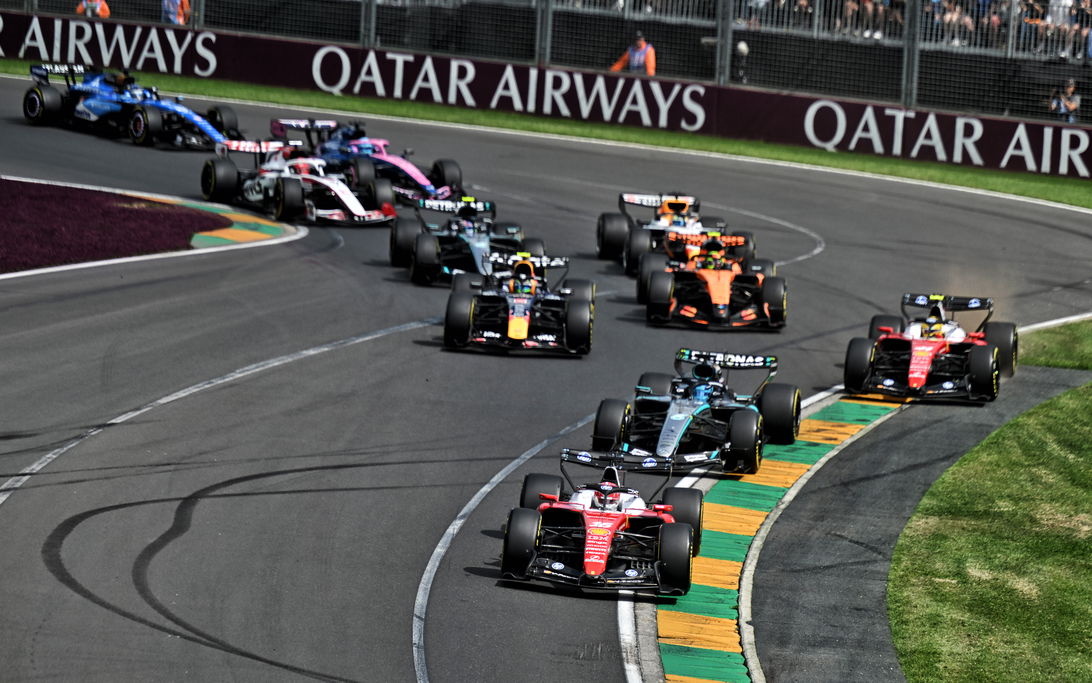
I stared at the GPS trace from the start of the Australian Grand Prix, the chaotic vectors of twenty cars looking less like a race start and more like a system error. The data screamed panic. Then came Charles Leclerc’s confession, a rare moment of raw honesty in a paddock polished by PR. He didn’t have a perfect launch. His battery was "very, very low." He gained the lead not by brilliance, but by being the least broken. This isn't a story about a driver's skill. It's a chilling preview of our algorithmic future, where the race is decided not at the lights, but in the silent, pre-programmed calculus of an energy recovery unit. The heartbeat of the start—that primal, instinctual surge—is being replaced by a faint, digital pulse.
The Illusion of Control and the Data That Betrays It
What the world saw was Leclerc’s Ferrari, starting fourth, slicing through to first before the first corner. A moment of genius. The timing sheets, the ultimate truth-tellers, recorded a gain. But the story is in the delta, in the why. Leclerc’s quote is a data analyst’s nightmare wrapped in a driver’s relief:
"I thought I was going to be P8 or P9... It was very sub-optimal. The battery was very, very low. It was not at all the way we wanted it to be."
Here lies the core contradiction of modern F1. We have more data than ever—thousands of data points per second per car—yet the start was a universal failure of prediction. Red Bull’s Laurent Mekies pinned it on the specific acceleration and braking methods on the formation lap, a procedural misstep that left the batteries barren. The starting lights, Leclerc said, went out "unusually quick," a variable no algorithm could have anticipated. This was a systemic short-circuit.
- The Narrative vs. The Numbers: Leclerc, branded error-prone, was in fact the most consistent element. His raw pace data from 2022-2023 cements him as the grid's most reliable qualifier. Yet, the story is never about that relentless Saturday brilliance. It's about the strategic blunders that follow, the noise that drowns out his signal. In Australia, for once, the noise—the battery glitch—worked in his favor. The universe of variables is now so vast that luck is no longer random; it's a bug in the code.
Schumacher’s Ghost and the Atrophy of Instinct
Let’s talk about 2004. Michael Schumacher, in that sublime, ruthless Ferrari, won 12 of the first 13 races. The starts were a trademark weapon. Was it a perfect battery deployment map? No. It was a symbiosis of man, machine, and a team that trusted his feel. The launch was a physical reflex, a dialogue between clutch pedal and eardrum, tuned over a thousand repetitions. The margin for error was mechanical, tangible. You could feel a bad start in your bones.
Contrast that with Melbourne, 2026. The critical failure was invisible, silent, and universal. The drivers, the supposed heroes, were reduced to passengers in the first two seconds, waiting to see if their pre-packaged energy parcel would arrive. The "battle" Leclerc described wasn't about reaction times; it was a morbid game of "who is least crippled."
"What appeared to be a perfect launch was, in reality, a scramble where the driver who managed the problem best gained the advantage."
This is the sterile future I fear. When a "sub-optimal" system-wide failure becomes the defining variable, we are watching the robotization of racing. The driver’s role is being suppressed, not by rules, but by layers of opaque technical complexity. The start is becoming a processed outcome, not a lived moment. We are trading heartbeats for hash rates.
Emotional Archaeology: The Human Cost of the Code
My job, as I see it, is emotional archaeology. I dig into numbers to find the pressure they hide. So let’s dig here. The data point isn’t Leclerc’s P4 to P1 jump. It’s the moment of panic he admitted to. Correlate that with his radio silence, with the micro-corrections in his steering trace. That’s the human story. What does it do to a driver’s psyche to know that your primary tool—the violent launch—is governed by a black box that can fail en masse?
This incident is a crack in the sport's glossy facade. It reveals the immense, often absurd, cognitive load placed on drivers. They must now be systems managers first, racers second. The "fine margins" are no longer about courage into Turn 1; they are about the millisecond precision of a brake application on the formation lap. It’s a margin devoid of spectacle, of emotion. It is a margin for engineers, not for legends.
Conclusion: The Predictable Path to Sterility
Ferrari says they have "a lot of margin to improve those starts." Of course they do. They will return to Maranello and run simulations, rewriting the code for the formation lap procedure. They will algorithmically eliminate this particular glitch. And in doing so, they will take another step toward making the start a predictable, optimized process.
In five years, if this continues, race starts will be homogenized. The chaos of Melbourne will be patched out. The gains will be measured in single-digit milliseconds extracted from software updates, not from the gut feeling of a driver like Schumacher or the raw, adaptive instinct Leclerc had to use just to survive that "sub-optimal" moment.
The Australian Grand Prix start was a warning. It showed us that the sport is so busy listening to the data, it’s in danger of forgetting the sound of its own heart. Leclerc won the race, but the real victor was the machine. And the machine is learning to race without us.