NewsEditorialChampionship
Motorsportive © 2026
Bricks and Brains: The Lego Helmet as a New Kind of Psychological Armor
6 March 2026Hugo MartinezDriver RatingsPREMIUM ANALYSIS

Bricks and Brains: The Lego Helmet as a New Kind of Psychological Armor

Hugo Martinez
Report By
Hugo Martinez6 March 2026

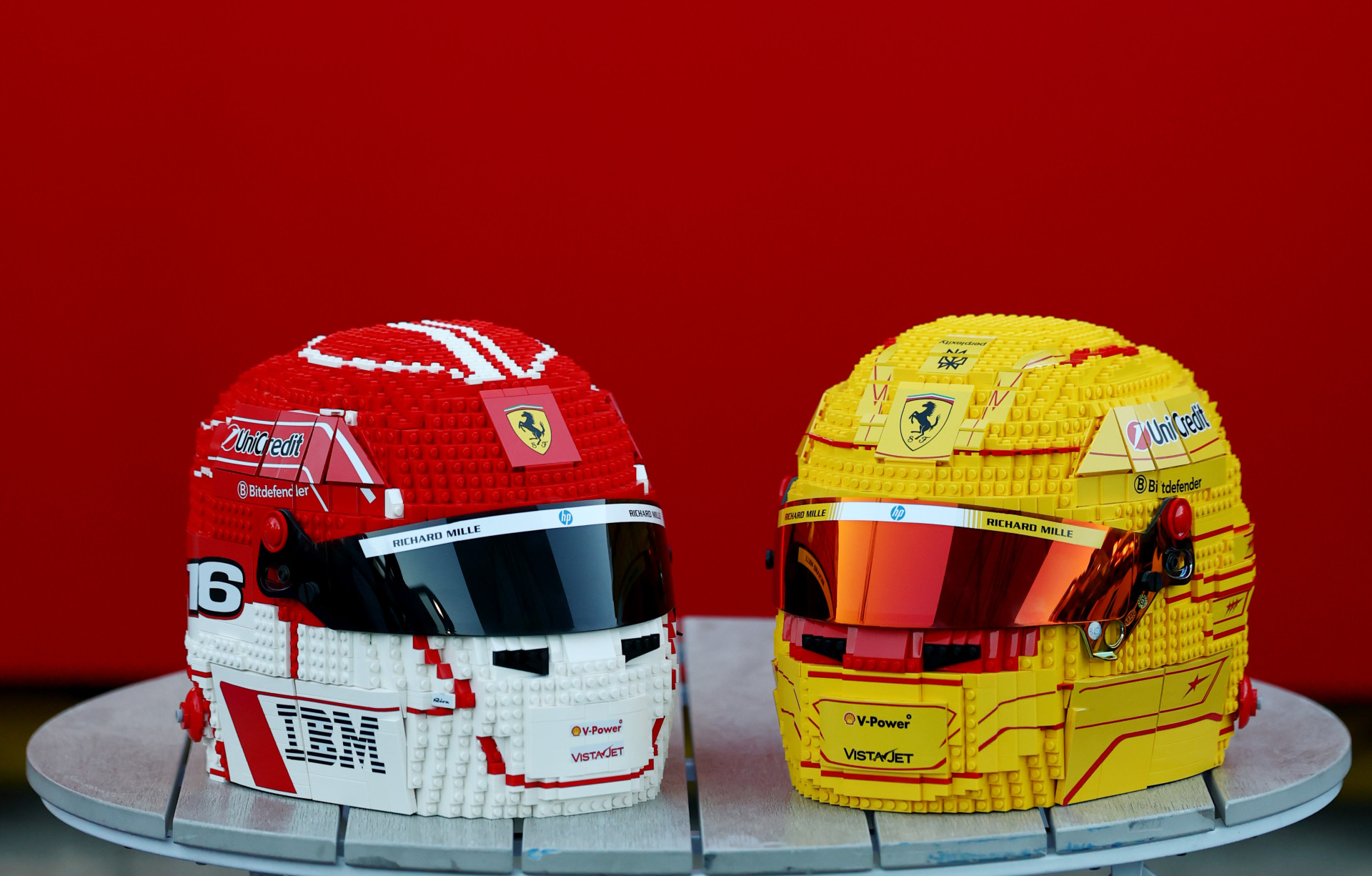
Ferrari drivers Charles Leclerc and Lewis Hamilton have launched official Lego sets of their 2025 race helmets. The collectibles, available from May 1, were revealed in Melbourne alongside unique, life-sized Lego replicas, marking a key expansion of Lego's Formula 1 merchandise.

In the high-stakes theater of Formula 1, a driver’s helmet is his sanctum. It is the final layer between the fragile human psyche and the screaming, violent world of carbon fiber and concrete. It is a canvas for identity, a shield for the mind. So when Charles Leclerc and Lewis Hamilton stood in the Melbourne paddock holding life-sized Lego replicas of these sacred objects, they weren't just promoting merchandise. They were engaging in a profound act of psychological curation. This was not a toy launch. It was a masterclass in persona management, a freezing of a fleeting emotional state into a static, collectible brick. Here is who I was in 2025, the models seem to say. Controlled, constructed, and now commodified.

The Constructed Self: From Carbon Fiber to ABS Plastic

The facts are delightfully literal. On March 6, 2026, the Scuderia Ferrari drivers unveiled official Lego sets of their 2025 helmet designs. Two display-sized sets, 886 pieces for Leclerc, 884 for Hamilton, available May 1. But the spectacle was the life-sized versions: 3,516 bricks for Leclerc, 3,744 for Hamilton, each a 26cm tall, 3kg monument that took master builder Ryan McNaught’s team 60 hours to construct.

Lego designers spoke of the challenge of capturing curves in bricks. I speak of the challenge of capturing a man in a marketing moment. Consider the timing: this is Hamilton’s first major Ferrari-branded merchandise launch since his seismic move. The helmet, his most personal item, is now rendered in the most universally accessible medium. The first-of-its-kind minifigure included in each set completes the metaphor: the driver, reduced to a smiling, clickable archetype. This is the endpoint of the modern F1 narrative—raw talent and traumatic experience sanded down into a system-compatible product, not unlike the systematic suppression of emotional outbursts we’ve witnessed in other champions.

"The helmet is the last place a driver can scream. Turning it into Lego is the process of making that scream silent, orderly, and suitable for a shelf."

Hamilton understands this duality better than anyone. He has spent a career building a public persona as meticulously as McNaught built that Lego model. He channels trauma into narrative, much like Niki Lauda did, but where Lauda’s was a story of raw survival, Hamilton’s is one of curated mission. Holding that Lego helmet, he wasn't just holding a model. He was holding the idea of 'Lewis Hamilton, Ferrari Driver'—an idea he has been constructing since the day he signed the contract.

The Wet-Weather Mind: What Lego Can't Capture

This is where the analysis must diverge from the press release. A Lego helmet is static. It is a snapshot. But the true value of a helmet is revealed in motion, specifically in chaos. Driver psychology trumps car aerodynamics in the wet. Under the cold spray of a rain-soaked circuit, decision-making under uncertainty strips away the constructed persona. The telemetry shows the micro-corrections, the brake traces, the throttle applications—a biometric readout of fear, aggression, or sublime calm.

Can you build that out of bricks? Can you capture the moment Leclerc’s mind calculates the diminishing grip through Eau Rouge, or the instant Hamilton decides to trust a gut feeling over his engineer’s dry-weather data? These helmets, in their real, carbon-fiber lives, have housed those split-second mental cataclysms. The Lego versions house nothing but air. They represent the containment of emotion, not its expression. They are the antithesis of the wet-weather gamble.

This is the central tension of modern driving. We celebrate the controlled, the consistent, the machine-like. We commercialize the sanitized snapshot. Yet we crave the human outburst, the flash of unrehearsed genius or despair that the system is designed to suppress.

The Inevitable Disclosure: A Future Built on Fragile Bricks

This launch is a harmless bit of fun. But it points to a more invasive future I believe is rushing toward us. If we are happy to dissect a driver’s brand via collectible bricks, how long before we demand to dissect his mind?

Within 5 years, F1 will mandate mental health disclosures after major incidents. A crash like Grosjean’s Bahrain fireball won’t just yield a physical report; it will trigger a sanctioned psychological evaluation. This new era of transparency will be sold as duty of care, but it will open a Pandora’s box of media scrutiny and potential scandal. Imagine the headlines: “Driver cleared to race but psych evaluation reveals acute anxiety.” The ‘manufactured’ champion who has been coached to show nothing will face a system that demands to see everything.

The Lego helmet, then, becomes a poignant relic. It represents the last era where a driver’s interior world could be implied, symbolized, and left to mystery. Soon, the contents of the helmet—the psyche within—may become just another data set for the federation to approve and the media to devour.

Conclusion: The Shelf-Life of a Persona

The Lego Editions Scuderia Ferrari HP helmets will be available for purchase on May 1, 2026. They are detailed, impressive, and will undoubtedly sell out. Fans will own a piece of history.

But as you place that brick-built Hamilton or Leclerc on your shelf, consider what you are really looking at. You are not looking at the fury of competition or the vulnerability of the man. You are looking at a calculated, collaborative construct. It is a beautifully engineered facade, as meticulously assembled as any race-winning strategy. It is safe. It is stable. It will never change.

And that is precisely what makes it so utterly different from the volatile, brilliant, psychologically complex individuals who will strap on the real versions and race into the unknown this Sunday. The bricks can replicate the shape. They can never contain the storm.

Comments (0)

Join the discussion...

No comments yet. Be the first to say something!