Oracle's AI Pivot Cuts Red Bull's Neural Cord; Hamilton's Ferrari Contract is a Data Point We're Misreading

Oracle plans up to 30,000 global layoffs, hitting engineers and programme managers linked to Red Bull, while Ralf Schumacher says Lewis Hamilton’s 2026 Ferrari form is driven by a stronger contract that gives him greater authority.
I stared at the two data streams side by side. On one screen, a press release from Oracle, cold and corporate, announcing the termination of up to 30,000 neural pathways—engineers, architects, the very minds that translate CFD simulations into carbon fiber reality for Red Bull. On the other, a gossip column masquerading as analysis, where Ralf Schumacher speculates that Lewis Hamilton’s 2026 form is a clause in a contract, not a function of grip and guile. Both stories are being read wrong. They’re not about business or politics. They’re about the slow death of feel, the final surrender to the algorithm, and a profound misreading of what a driver’s authority actually means. The numbers, as always, tell a deeper, more unsettling story.
The 30,000 Variables Removed: When a Sponsor Becomes the Spinal Column
Oracle isn't just a logo on a bicep. Since 2023, they’ve been Red Bull Racing’s cloud-based central nervous system. Their layoffs, announced on April 5, 2026, targeting "engineers, architects, and programme managers tied to the F1 operation," aren't a budget trim. They're a lobotomy. The immediate cuts in the U.S., India, Canada, and Mexico represent a global degradation of a proprietary data lattice.
"The cuts are part of Oracle’s pivot toward artificial-intelligence investments." This is the core of it. The parent organism is redirecting resources to build a larger, generalized brain, starving the specialized, Formula 1-specific synapse. For Red Bull, this isn't a sponsorship headache; it's an existential data famine.
Consider what they lose:
- Real-time strategy modeling: The millisecond advantage in predicting a Safety Car window.
- Predictive wear analytics: The algorithm that whispers "left-front brake disc 0.3mm beyond optimal wear" before the driver feels the vibration.
- Logistics optimization: The invisible web that ensures a rear wing spec arrives in Baku before the freight door closes.
This is the sterile, robotic future I fear, arriving not with a bang but with a pink slip. Red Bull’s response will be telling. Will they seek another tech partner, or will they be forced to rely more on driver intuition and track feel? Ironically, this corporate severance might force a return to a purer form of racing. But the timing sheets from the next five races will show the truth: a dip in strategic precision, a rise in operational latency. The car might be the same, but the mind guiding it will have suffered a traumatic brain injury.
Hamilton's "Authority" & The Ghost of Schumacher's Consistency
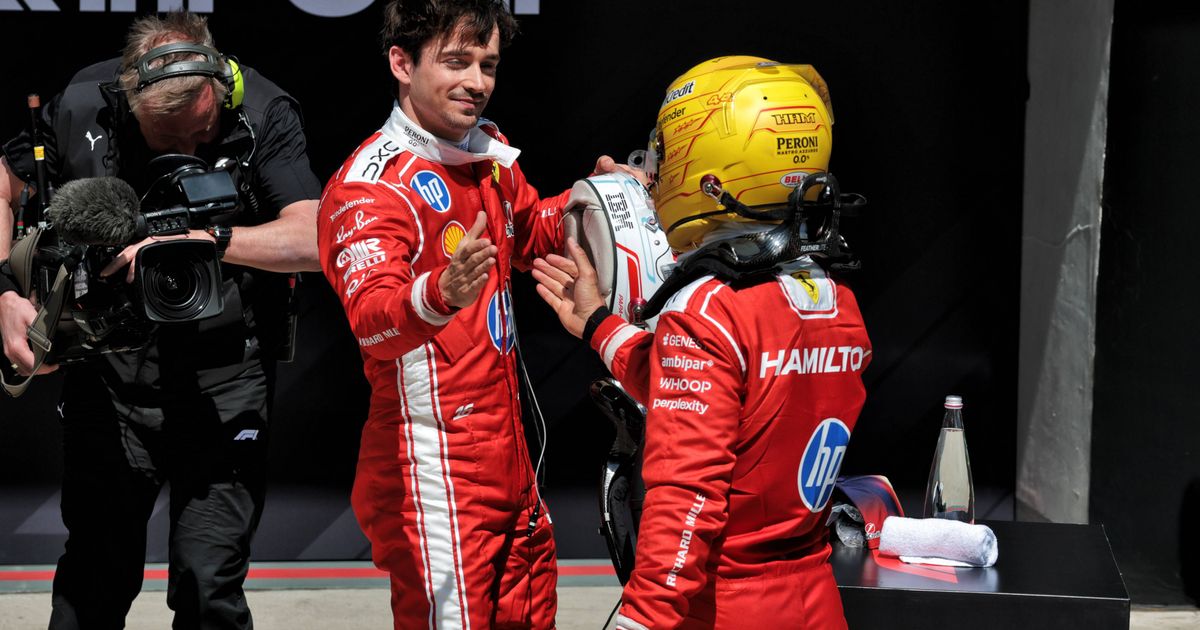
Then there's the Hamilton narrative. Ralf Schumacher posits that Lewis’s "unexpected form" is due to a "newly weighted Ferrari contract granting him unprecedented authority," making him the "de-facto number one." This is a superficial reading of a deep data set. It confuses symptom for cause.
Hamilton’s contract isn't the source of his speed; it’s a symptom of Ferrari’s institutional failure. They aren't granting him authority out of generosity. They are codifying, in legal terms, a truth they have spent years denying Charles Leclerc: that a driver’s consistent, peak performance is irreplaceable, and must be insulated from the team’s legendary strategic entropy.
Let’s talk about Michael Schumacher, 2004. The data from that season isn't just fast; it's metronomic. His qualifying consistency, his race pace management, it was a masterclass in human-as-algorithm, but one driven by sublime feel and a team built around his feedback. Today, Ferrari gives Hamilton "independence" in setup and strategy not because he’s a tyrant, but because they finally acknowledge that layering 50 layers of real-time telemetry over a driver’s visceral understanding of the car’s balance is a recipe for mediocrity.
"This shift may also affect the team’s internal dynamics, as other drivers and engineers adjust to a new pecking order." This is the real story. Not Hamilton’s power, but the validation of a driver’s raw data. Leclerc’s 2022-2023 qualifying statistics—the most consistent pole contender on the grid—were forever buried under the narrative of his "errors," errors that often stemmed from being overruled by pit wall gambles or compensating for a car setup built by committee. Hamilton’s contract is a firewall against that same fate. It is a data point proving that Ferrari has, belatedly, learned that the greatest supercomputer is still the driver’s subconscious, fed by fingertips and vestibular system.
Conclusion: The Human Element, Under Siege and Misunderstood
So here we are. Two seismic shifts, both misinterpreted.
Oracle’s layoffs are framed as a business story, but they are a warning shot in the war for the sport’s soul. They represent the prioritization of a generalized, omnipotent AI over the bespoke, human-centric data craft that makes a race team excel. The danger isn't the loss of money, but the loss of meaning in the numbers.
Hamilton’s Ferrari contract is framed as a power play, but it is actually a desperate, data-driven correction. It is Ferrari purchasing, at great cost, a return to the Schumacher principle: find a driver whose pace data is a flatline of excellence, and get every other variable—strategy, psychology, hierarchy—to orbit around that immutable fact.
The 2026 season will now be a brutal live experiment. Can Red Bull’s driver-centric genius (a fading art in itself) compensate for a degraded data backbone? Can Ferrari’s new, driver-empowered model finally harness a raw pace they’ve historically squandered? Watch the sector times. Watch the reaction times at race starts. Watch the strategic calls. The numbers won’t show you contracts or layoffs. They’ll show you the heartbeat of the sport, slowing under the weight of remote computation, or finding a new, fierce rhythm under the renewed trust in the human behind the wheel. I know which history, and which data set, I’m betting on.