Piastri's Penalty Reveals Flaws in F1 Racing Guidelines
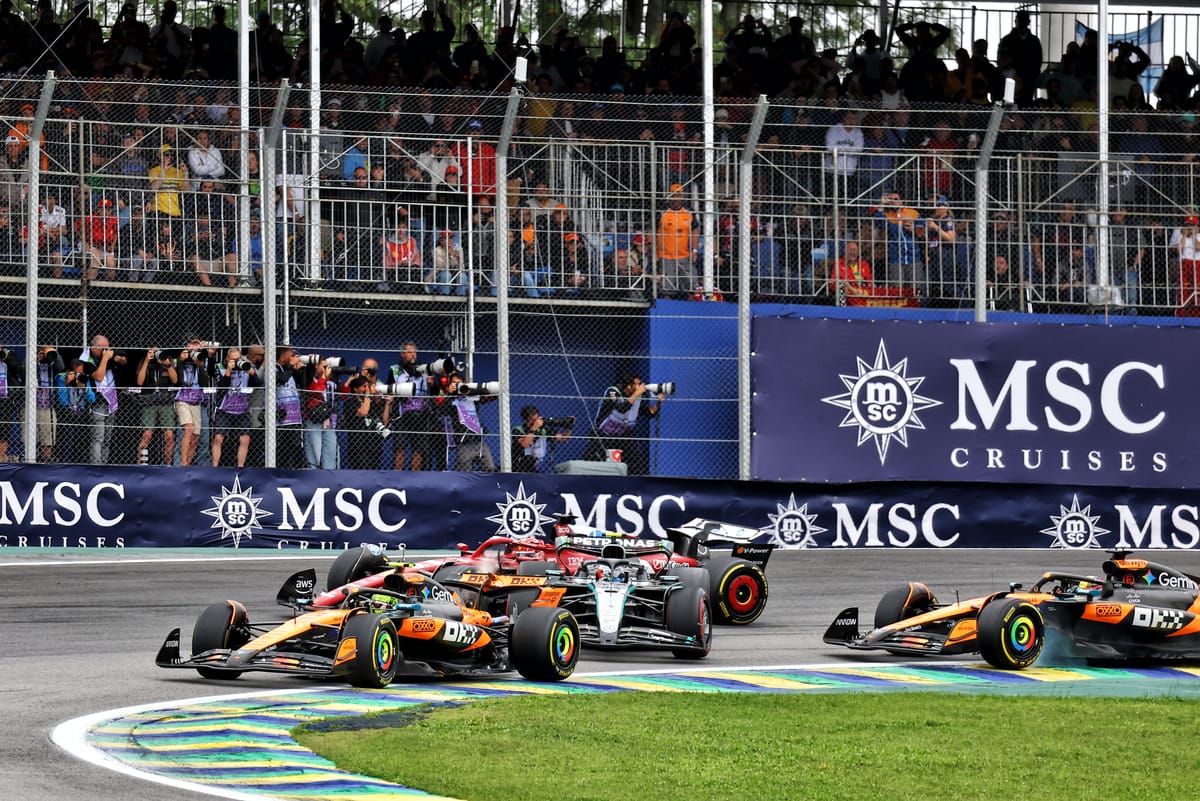
Oscar Piastri's penalty at the Brazilian Grand Prix has ignited calls for urgent revisions to Formula 1's racing guidelines, or how they're enforced. The incident, involving Piastri, Antonelli, and Leclerc, exposed how the current stringent rules often lead to penalties for 'racing incidents' rather than clear wrongdoing, dampening wheel-to-wheel action and creating a paradoxical environment for drivers.
Oscar Piastri's penalty in the Brazilian Grand Prix has sparked debate, highlighting the urgent need for revisions to Formula 1's racing guidelines or a fundamental shift in their application for the upcoming season. The incident, involving Piastri, Kimi Antonelli, and Charles Leclerc, underscores how the current overly prescribed rules are hindering genuine racing.
Why it matters:
After years of evolving regulations, F1's current racing guidelines are creating a paradoxical situation where drivers are penalized for attempting to race while adhering to an increasingly rigid rulebook. This not only diminishes wheel-to-wheel action but also distorts accountability, making 'racing incidents' a rarity and leaving drivers, teams, and fans frustrated.
The Details:
- The Incident: Piastri was penalized for a collision with Antonelli, which subsequently took out Leclerc, during the Brazilian Grand Prix. Replays, interpreted strictly by current guidelines, led to the conclusion that Piastri was at fault.
- The Rule: The 2025 guidelines state that a car on the inside must have its front wheel at least level with the wing mirror of the car it's trying to overtake to be left space. Piastri, attempting to back out, was essentially penalized for not being more aggressive and potentially causing a more severe crash.
- Two-Dimensional Approach: Critics argue this rule-making creates a 'who needs to do what, by where and when' scenario, removing shared accountability in multi-car incidents.
- Flawed Guidelines: The initial version of the guidelines was already contentious, and changes for 2025 have exacerbated issues, with some feedback reportedly ignored during their drafting. The emphasis has shifted to an 'apex dash,' making outside overtakes harder and potentially absolving drivers who contribute to accidents by pinning opponents.
- The Context: The collision occurred at a notoriously challenging corner in Brazil—a key overtaking spot with a tight apex and downhill drop, possibly even with damp patches.
- Leclerc's Role: Passing on the outside, Leclerc took a mitigated risk but was an innocent victim of circumstances, leaving ample space.
- Piastri's Approach: In 'championship recovery mode,' Piastri saw an opportunity and was entitled to attempt the inside move. He had a good run and maintained control despite a lock-up, which was a reaction to Antonelli closing the space.
- Antonelli's Role: Positioned in the middle, Antonelli squeezed Piastri to the apex, contributing significantly to the incident. However, his position was also the most challenging.
The Big Picture:
The current interpretation of F1's racing rules often demands a penalty even when an incident, by general racing principles, might not warrant one. The 'right' penalty is thus often applied for the 'wrong reasons,' driven by overly prescriptive guidelines rather than the nuanced reality of on-track racing.
What's next:
F1 and the FIA must reconsider their approach. Potential solutions include:
- Reverse Engineering Guidelines: Acknowledging that certain situations shouldn't result in penalties and then designing rules to support that outcome.
- Scrapping Guidelines: Reverting to the International Sporting Code and a 'don't be a twat' rule, allowing for subjective interpretation and varying levels of aggression.
- Professional Stewarding: Investing in full-time, professional stewards to bring consistency and expertise to decision-making.
The goal is to move away from a version of F1 that distorts accountability, misplaces the emphasis of wheel-to-wheel racing, and generates new problems without resolving existing ones, ultimately restoring the excitement and fairness of F1 racing.