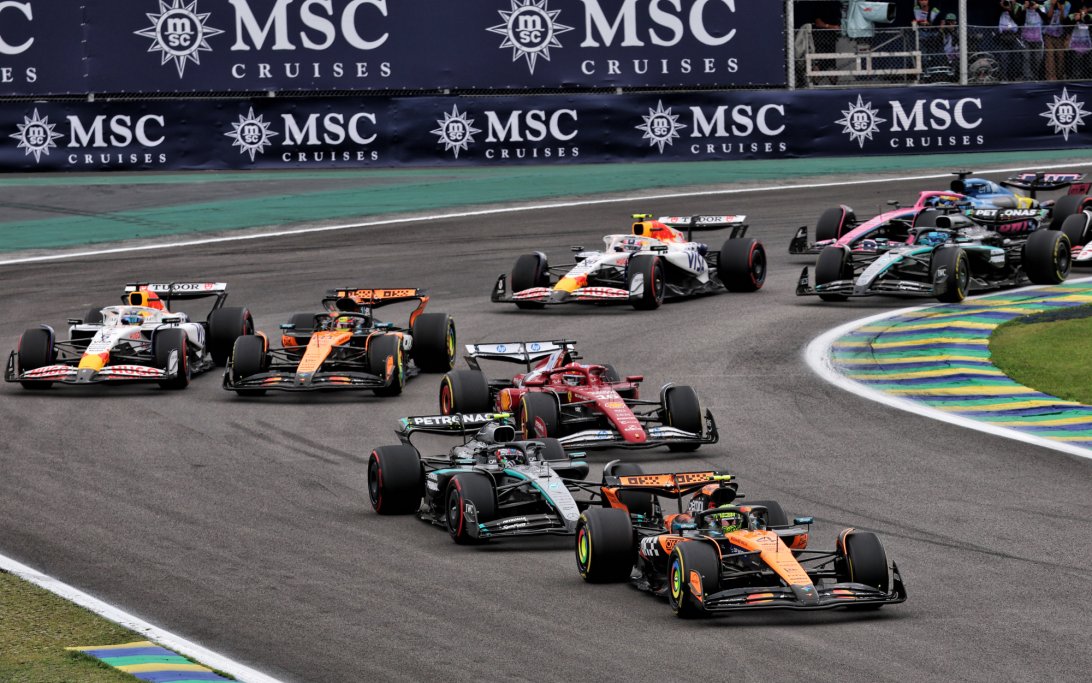
Red Bull's Reality Check in Brazil: Ride Height Woes and Ferrari's Triumph
Red Bull faced significant challenges at Interlagos due to the RB21's ride height sensitivity on the bumpy track, hindering their low-downforce setup. This starkly contrasted with Ferrari's effective adjustments, which allowed Charles Leclerc to perform strongly. The race highlighted the critical impact of subtle car adjustments on ground-effect F1 cars and could influence the tight championship battle as the season nears its end.
Red Bull faced a harsh reality check at Interlagos, as their low-downforce setup, effective elsewhere, struggled with the circuit's bumps and elevation changes. This exposed a critical weakness in the RB21's ride height sensitivity, despite recent gains that had seen Max Verstappen close in on the championship leader.
Why it matters:
After a strong run of three wins in five races, Red Bull's struggles in Brazil highlighted the unpredictable nature of ground-effect cars. Even championship contenders can be derailed by subtle setup miscalculations, especially on challenging circuits. This event potentially impacts the tight championship battle, as Lando Norris's lead remains significant.
The Details:
- Red Bull's Struggles: At Interlagos, all F1 teams opted for a low-downforce setup. However, the circuit's bumps and elevation changes made it impossible for Red Bull to run their car low enough to generate optimal grip.
- Ride Height Sensitivity: The RB21 suffered from a lack of grip at both ends, leading to understeer at the front and poor traction at the rear. Max Verstappen reported having to "tame" his engine, reducing power to prevent wheelspin, a significant compromise on a straight-line speed-dependent circuit.
- Recent Momentum Halted: Since the Italian Grand Prix, Red Bull had believed they were turning a corner with the RB21, thanks to a new floor package. Three wins in five races for Verstappen had narrowed the championship gap to Lando Norris to 36 points, raising hopes for a fifth consecutive drivers' championship.
- Ferrari's Success: While Red Bull floundered, Ferrari found their sweet spot. They used the same low-downforce rear wing as in Saudi Arabia, but critical adjustments to ride height and suspension after the Saturday sprint gave Charles Leclerc optimal grip and stability.
- Ferrari's Aerodynamics: Ferrari's SF-25 featured a thinner rear wing profile with reduced curvature to minimize drag. The wing's center section was slightly lower than the outer edges for enhanced efficiency, and a flatter beam wing directed airflow to extract more downforce from the floor.
- McLaren's Approach: McLaren followed similar principles, with their MCL39 sporting a low-downforce rear wing with an almost straight upper edge, gently sloped at the central mounting point to reduce drag.
The Big Picture:
This race starkly demonstrated the extreme sensitivity of the current generation of ground-effect cars. Even minor adjustments in ride height can drastically alter a car's performance, turning a potential podium contender into a struggler. It underscores that even the most dominant teams face a 'grey area' of unpredictability under specific circuit conditions.
What's next:
With only three races left in the 2025 season, teams will be meticulously analyzing their Brazil performance. For Red Bull, addressing the ride height sensitivity will be crucial if they are to reclaim their championship form. For Ferrari and McLaren, consistency in setup optimization will be key to capitalize on their rivals' stumbles as the season concludes.