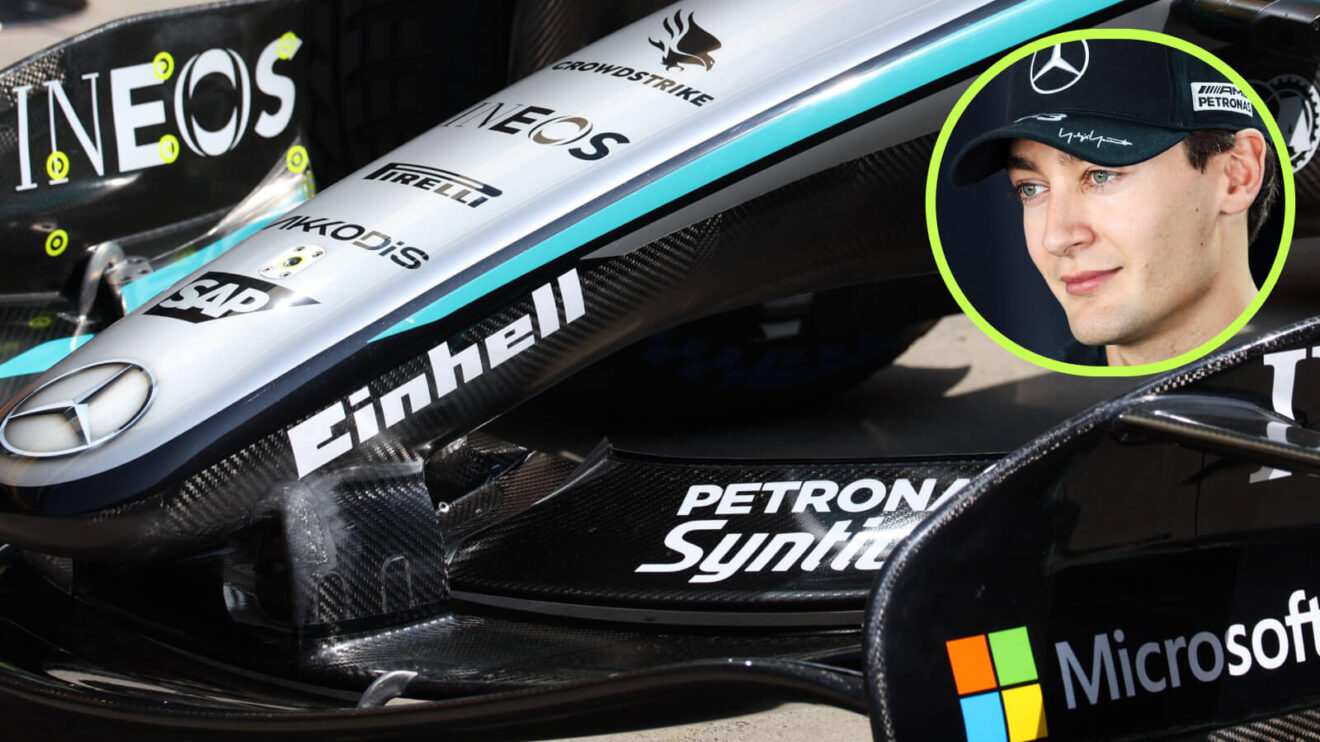
Russell: Mercedes' Controversial Front Wing Was a 'Problem, Not an Advantage'
George Russell clarifies that the unusual movement of Mercedes' front wing in China was an unintentional technical problem, not a secret advantage. The flaw, which delayed the wing's transition and nearly cost Kimi Antonelli his win, highlights the challenges of perfecting complex new aerodynamic systems under intense regulatory scrutiny.
George Russell has clarified that Mercedes' front wing, which came under scrutiny in China for its unusual movement, was a technical flaw and not a performance advantage. The issue, which caused a delay in the wing transitioning between straight-line and cornering modes, nearly compromised Kimi Antonelli's first grand prix win and prompted questions about regulatory compliance.
Why it matters:
In Formula 1, where technical innovations are constantly pushed to the limit, the line between a clever interpretation of the rules and a breach is razor-thin. This incident highlights the intense pressure on teams to develop complex aerodynamic solutions while ensuring absolute reliability. A perceived advantage can quickly become a liability, affecting not only car performance but also a team's reputation and a driver's crucial result.
The details:
- The controversy stemmed from onboard footage of Kimi Antonelli's car in Shanghai, which showed the front wing's active aerodynamics behaving erratically during the transition from a straight to a corner.
- The wing hesitated in a mid-position while Antonelli was braking, taking longer than permitted to fully return to its cornering configuration.
- This appeared to contravene Article 3.10.10 of the F1 technical regulations, which mandates that such transitions must be completed within 400 milliseconds.
- Russell was adamant that the behavior was unintentional and detrimental. He explained that the issue contributed to Antonelli's lock-up and that solving it is a current challenge for the team.
- The driver provided technical context, noting that unlike the rear wing—which uses aerodynamic force to assist its movement—the front wing must work against the wind pressure at high speed, making its operation more mechanically demanding.
What's next:
Mercedes will be working to resolve this reliability flaw swiftly. While the FIA's stance on the matter remains a point of interest, a fix is crucial for consistent performance. For Antonelli and Russell, a reliable front wing system is key to maximizing their car's potential and converting pace into solid results, starting with the upcoming rounds. The episode serves as a reminder that in the relentless pursuit of speed, mastering the fundamentals of new systems is just as important as their theoretical performance.
Don't miss the next lap
Get the deep dives and technical analysis from the world of F1 delivered to your inbox twice a week.
Zero spam. Only high-octane analysis. Unsubscribe anytime.
Join the inner circle
Get the deep dives and technical analysis from the world of F1 delivered to your inbox twice a week.
Zero spam. Only high-octane analysis. Unsubscribe anytime.
Continue Reading
View More News