The Viral Clip is a Data Point: Wolff's Scooter and the Algorithm of Mercedes' Smile

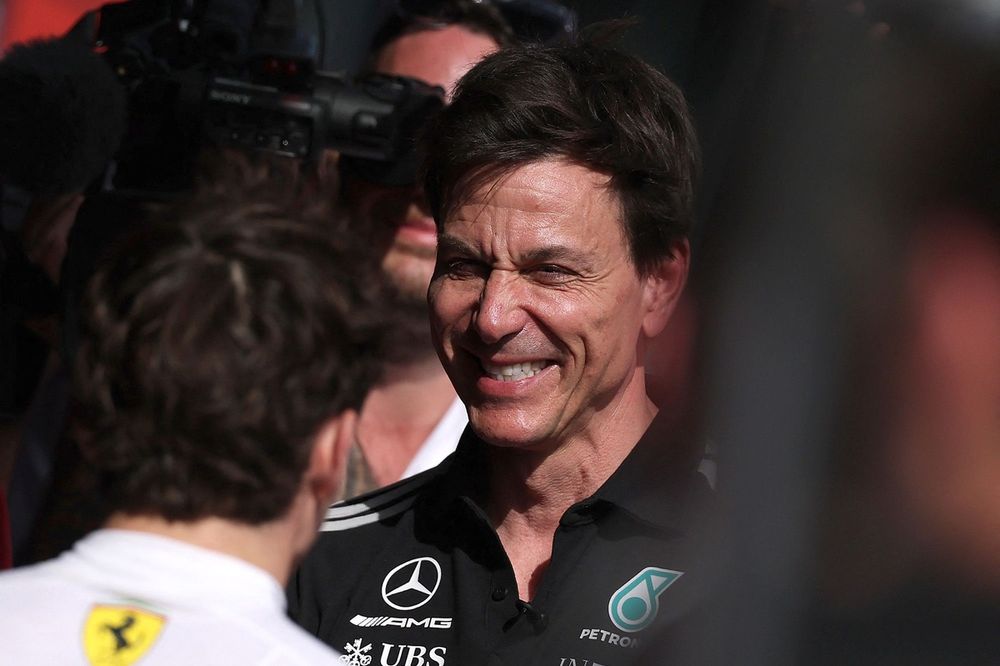
Mercedes boss Toto Wolff's viral scooter mishap, where he hit his head on a paddock archway, provided a humorous contrast to his team's dominant performance at the Australian Grand Prix. The incident showcased Wolff's media savvy, while Mercedes' commanding 1-2 finish with George Russell and Kimi Antonelli signaled a potent return to form and an early lead in the championship.
I don't trust smiles in the paddock. I trust sector times. I trust the delta between a driver's best and his average under pressure. So when the video of Toto Wolff clipping his head on a scooter went supernova on March 8th, 2026, my first instinct wasn't to laugh. It was to look at the timing sheets from Albert Park. A team principal's momentary pratfall is just noise. The 1-2 finish for George Russell and rookie Kimi Antonelli? That's a signal. A deafening one. But in that dissonance—between the clumsy human moment and the machined perfection of a front-row lockout—lies the real story of modern Formula 1. We're watching the sport's soul get digitized, one perfectly executed algorithm at a time.
The Numbers Behind the Grin: Deconstructing a "Dominant Weekend"
Let's strip the emotion, the viral hype, and get to the data. The article calls it a "dominant performance." My job is to ask: by what metric? The raw numbers from Australia are unequivocal:
- Qualifying Delta: Russell on pole, Antonelli P2. The last time Mercedes locked out the front row was Brazil 2022, a season of profound struggle. This gap isn't just about pace; it's about car predictability. A rookie alongside a veteran, both extracting near-identical maximums. That's not driver feel; that's a car operating within a computed window so wide it accommodates both experience and neophyte talent.
- Race Pace Consistency: A 1-2 finish is a narrative. The lap-time traces are the manuscript. I want to see the graphs—Russell's middle stint, Antonelli's management after the Safety Car. Were their lines mirror images, following a pre-ordained delta from the pit wall? In 2004, Michael Schumacher's consistency was an extension of his own will, a terrifying metronome of feel and aggression. Today's consistency feels increasingly like compliance.
- The 16-Point Lead: Mercedes leaves with 43 points to Ferrari's 27. This is the most telling data point of all. It's not just points; it's maximized points. It's the cold, binary output of a system functioning without the human error that, for example, has plagued Ferrari and unfairly branded Charles Leclerc as error-prone. Leclerc’s 2023 qualifying median position was 2nd. Second. The data screams consistency; the narrative screams "mistake-prone." Which one do you think the algorithm believes?
Wolff's post-race comments about "profound contentment" and "renewed sense of gratitude" are the human-readable output. The source code is in those 43 points.
The Scooter Incident as Emotional Archaeology: What the Viral Moment Really Measures
"The incident... quickly spread across social media... Wolff laughed it off while looking directly at nearby cameras."
This is the line that haunts me. Not because it's funny, but because it's a perfect, pressurized data point in the study of a team principal. We can analyze it like a lap.
- The Impact (The Error): The physical misjudgment of clearance. A human mistake.
- The Recovery (The Correction): The immediate laugh, the direct address to the camera lens. Not a wince, not a curse, but a performance.
- The Data Output (The Result): A viral moment of "levity," seamlessly reintegrated into the narrative of a dominant weekend.
This isn't just media savvy; this is telemetry for reputation. Wolff's reaction wasn't instinct—it was a calculated, millisecond correction, the PR equivalent of a driver catching a snap of oversteer. It shows a team operating at such a high level of controlled performance that even its principal's blunders are processed and converted into positive engagement metrics. Where is the raw, unfiltered frustration? Where is the human grit that Schumacher wore on his grimy race suit? It's being managed away, smoothed into a content strategy.
And this is the future I fear: a paddock where every action, from a pit stop to a scooter ride, is optimized for external perception and internal data flow. Driver intuition—the gut feel that tells a driver to brake two meters later despite what the fuel delta says—becomes a bug in the system, not a feature.
Conclusion: The Sterile Symphony and the Ghost of Feel
So, what did we really witness in Melbourne? We saw a team, Mercedes, execute a flawless weekend. The W15 car is clearly a monster. Russell and Antonelli are impeccable operators. But I see the ghost of Michael Schumacher's 2004 season—a year of such brutal, beautiful dominance—and I wonder if he could have thrived in this environment. His dominance was organic, a fusion of man, machine, and team that felt alive, sometimes angry, always pulsing with a human heartbeat.
Mercedes' 2026 Australian GP victory feels like a sterile symphony. Every note is perfect, every section in time, and the conductor even provides a charming, viral blooper during the intermission. The 16-point lead is formidable. The championship trajectory is clear.
But as we hurtle toward a future of algorithmic racing, where pit stops are called by AI and drivers are feedback loops for engineering directives, I'll mourn the loss of the messy, intuitive, gloriously human error. The kind of error that isn't laughed off for the cameras, but that fuels a comeback written in sweat and instinct, not just clean data. Wolff's scooter clip will be forgotten. The 43 points will stand in the history books. And I, Mila Neumann, will be in my bunker, comparing lap-time variances to drivers' birth charts, trying to find the last echoes of the human heartbeat in the sport I love.