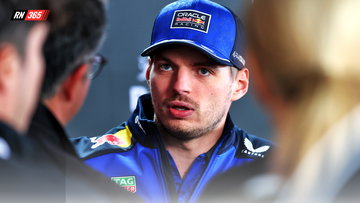
Verstappen Ejects Journalist as FIA Announces Qualifying Rule Change
At the Japanese GP, Max Verstappen removed a journalist from a press conference. Simultaneously, the FIA moved to ban the controversial qualifying tactic of drivers creating excessively large gaps before their final laps, issuing a new technical directive to curb dangerous impeding.
Max Verstappen ejected a journalist from a press conference at the Japanese Grand Prix, an incident that coincided with the FIA announcing a significant change to the qualifying procedure. The governing body has clarified the rules regarding impeding, specifically banning the practice of drivers creating large gaps before their final flying laps in Q1, Q2, and Q3.
Why it matters:
The dual developments highlight ongoing tensions in Formula 1 between driver-media relations and the continuous evolution of sporting regulations. Verstappen's direct action reflects drivers' growing assertiveness in controlling their media environments, while the FIA's rule tweak is a direct response to teams exploiting a grey area, aiming to ensure fairer and safer qualifying sessions by eliminating dangerous gamesmanship.
The details:
- The Ejection: During a media session at Suzuka, Verstappen asked a journalist from the publication RacingNews365 to leave, reportedly due to the nature of their questioning. The exact trigger remains unclear, but it underscores the reigning champion's low tolerance for lines of inquiry he deems inappropriate.
- The Rule Change: The FIA issued a new technical directive (TD/066) clarifying Article 33.4 of the Sporting Regulations on impeding. It explicitly states that any driver creating a significant gap before the final push lap in qualifying will be considered to be driving "unnecessarily slowly" and can be penalized.
- The Trigger: This clarification was prompted by observed behavior, particularly in Q1, where drivers would slow excessively to create a clean air gap for their lap. This tactic, while strategically sound for track position, led to dangerously slow cars on racing lines and near-misses, compromising safety for others on hot laps.
- Official Wording: The TD specifies that in the final sector of an out-lap during qualifying, drivers must not drive "unnecessarily slowly," which is defined as a lap time more than 120% of their best sector time. This provides a clear, measurable benchmark for stewards.
What's next:
The immediate impact will be felt at the next Grand Prix, where teams and drivers must adapt their qualifying run plans to comply with the new directive. Expect more consistent out-lap speeds and potentially fewer dangerous traffic jams in qualifying's closing moments.
- The Verstappen incident may lead to further discussions between the FIA, teams, and the GPDA (Grand Prix Drivers' Association) about media protocol and the boundaries of driver interaction with the press.
- Long-term, the rule change aims to standardize behavior and remove a strategic variable that added unnecessary risk, making the qualifying hour more straightforward and safety-focused.
Don't miss the next lap
Get the deep dives and technical analysis from the world of F1 delivered to your inbox twice a week.
Zero spam. Only high-octane analysis. Unsubscribe anytime.
Join the inner circle
Get the deep dives and technical analysis from the world of F1 delivered to your inbox twice a week.
Zero spam. Only high-octane analysis. Unsubscribe anytime.
Continue Reading
View More News