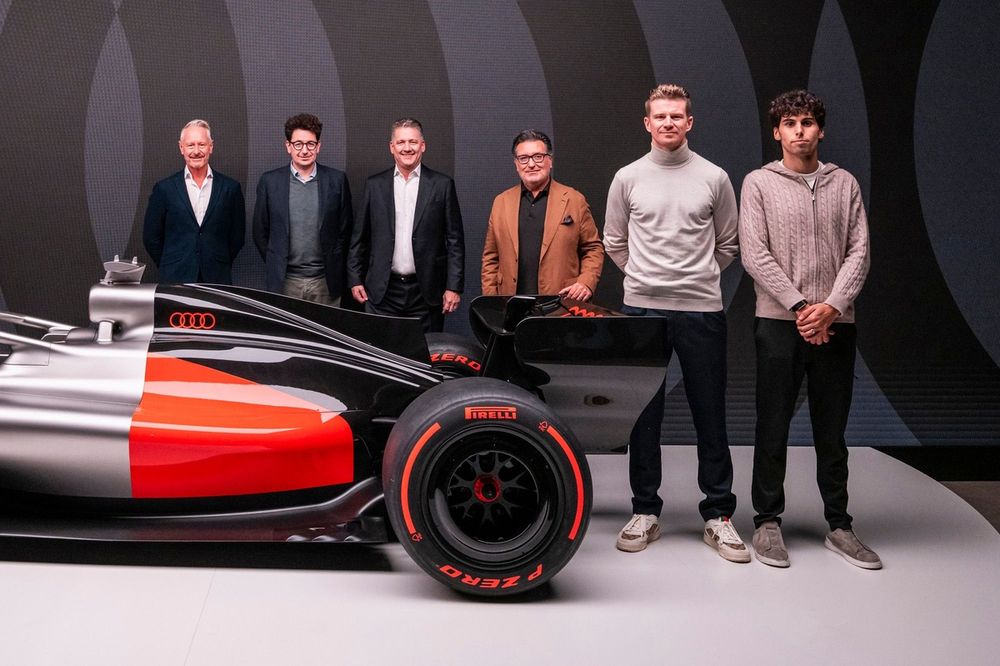
Audi's 2026 F1 Grand Reveal: Ambitions, Challenges, and a Long-Term Vision
Audi has unveiled its ambitious 2026 Formula 1 entry, setting a target to challenge for titles by 2030. The German automaker plans to develop both its power unit and chassis in-house, viewing this integrated approach as crucial for success. Despite the immense challenge, Audi's CEO Gernot Doellner is fully committed, and Sauber's recent performance surge is aiding the transition, signaling a serious long-term investment in F1's future.
Audi officially launched its 2026 Formula 1 entry in Munich, unveiling a concept livery for its inaugural F1 challenger. The event shed light on the brand's long-term commitment, aggressive strategy, and the significant undertaking of building a dual chassis and power unit operation from the ground up.
Why it matters:
Audi's entry into Formula 1 as a full factory team, developing both power unit and chassis, signifies a major shift in the sport's landscape. This substantial investment from a global automotive giant not only validates F1's growing appeal but also promises to intensify competition at the pinnacle of motorsport, potentially reshaping the pecking order by the end of the decade.
The details:
- Long-Term Ambition: Audi views F1 as a long-term project, targeting championship titles by 2030. CEO Gernot Doellner outlined a phased approach: "challenger years" in 2026-2027, becoming "real competitors" from 2028, and fighting for the championship by 2030.
- Stability in Regulations: Audi firmly opposes any fast-tracking of regulation changes, emphasizing the need for stability beyond 2026. Doellner stated that fundamental shifts are not economically feasible within a two-year period, advocating for the next major regulation change around 2029 or 2030.
- Dual Chassis and Power Unit Development: Audi is taking on the complex challenge of developing both the power unit in Neuburg and the chassis at Sauber's Hinwil base simultaneously. Mattia Binotto, CTO and COO of the Audi F1 project, stressed that full control over both aspects is a "must" for achieving their winning ambitions.
- CEO's Personal Commitment: Gernot Doellner has fully embraced the F1 project, accelerating the takeover of Sauber and bringing in an external investor (Qatar's sovereign wealth fund) to strengthen the project's foundation. He asserts, "it's absolutely my project."
- Sauber's Resurgence: Sauber's improved performance in recent months, including Nico Hulkenberg's podium finish and consistent point challenges, is easing Audi's transition. Team principal Jonathan Wheatley highlights a renewed team spirit and belief, citing their ability to build a new car in an incredibly short time as evidence.
- New Design Language: The 2026 concept livery reveals a distinct Audi design language, featuring black, silver, and red hues, a stark contrast to Sauber's current livery. This new identity will extend to the Hinwil headquarters, with significant upgrades including a new staff campus and motorhome.
- Mutual Learning: Audi acknowledges that F1 is vastly different from series production car development. While they will bring some methodologies, they also expect to learn from F1's speed and teamwork. Doellner stated that corporate Audi can learn "a lot regarding teamwork, team set-up and speed."
- Tech Transfer: The 2026 engine rules, with their focus on efficiency and sustainable fuels, are expected to enable technology transfer between F1 and Audi's road car development, making the sport highly relevant for the brand.
The big picture:
Audi's arrival is a clear testament to F1's booming global presence, particularly in the North American market. The presence of F1 CEO Stefano Domenicali at the launch underscored the sport's high regard for Audi's involvement. This partnership is seen as the "start of a new era of Formula 1," with Audi positioned not just as a participant, but as a key player in growing the championship and driving technological innovation, especially in sustainability.
What's next:
With their ambitious timeline and a clear strategic roadmap, Audi's next steps will involve intensifying development in Neuburg and Hinwil. The focus will be on resolving the complexities of integrating the power unit and chassis operations, while leveraging Sauber's recent momentum. The world will be watching to see if Audi can deliver on its promise to contend for championships by 2030, marking a formidable new chapter in Formula 1.