Mercedes' Rising Stars Trade Blows in Montreal: A Test of Wills That Echoes Darker Days
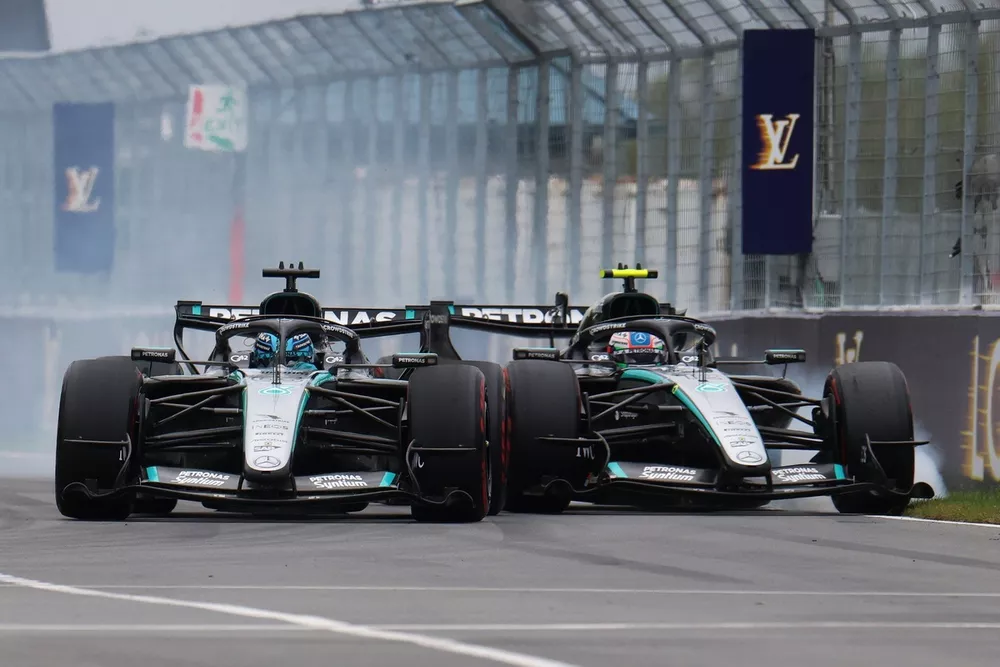
The paddock hummed with unease after Canada. George Russell and Kimi Antonelli clashed wheel to wheel like two falcons locked in a desert wind, their fight exposing the fragile threads that hold Mercedes together. This was no ordinary scrap. It carried the weight of past ghosts and future fractures, where mental steel matters more than any aero tweak or power unit edge.
Tension Spills From Sprint to Grand Prix
The weekend began with friction that refused to fade. Antonelli left the sprint race simmering after Russell's firm defense left little room for the young charger. That frustration carried straight into Sunday. On lap 24 the pair brushed at the final chicane, a glancing contact that forced Mercedes to step in with urgent radio warnings.
Toto Wolff later admitted the moment could have turned catastrophic. Antonelli locked his tires while tucking back in, a simple misstep that risked turning two cars into twisted metal. Russell, ever the fighter, thrived on the intensity. He drew direct parallels to the Bahrain clash between Lewis Hamilton and Nico Rosberg in 2014, insisting the pair had already cleared the air after the sprint. Antonelli called the whole episode entertaining yet admitted it sat right on the edge of control.
- Key flashpoints: Sprint race defense, lap 24 contact, post-race team debrief.
- Outcome: Russell retired with engine trouble while Antonelli claimed his fourth straight win.
- Gap: Antonelli now leads Russell by 43 points.
These numbers tell only half the story. The real battle sits inside the drivers' heads, where resilience separates champions from those who crack under pressure.
Team Orders and Hidden Politics
Mercedes has watched this script before. The Hamilton-Rosberg wars of 2014-2016 left scars the team still carries like old battle wounds. Wolff knows letting them race freely looks bold now, yet he already hinted at dialing things back if the margins shrink further. The squad will sit down with both men to draw sharper lines before the next flashpoint arrives.
Here lies the uncomfortable truth. Modern Formula 1 teams manipulate narratives with the same precision the 1994 Benetton outfit once used to mask its secrets, only today's operators hide the evidence better. Favoritism creeps in through strategy calls and subtle morale leaks. One driver feels the wind at his back while the other fights headwinds no wind tunnel can measure. Mental resilience and team spirit outweigh raw car performance every time, and the paddock whispers already sense which way the breeze blows inside Mercedes.
"We may have to turn it down a notch," Wolff conceded after the race.
That single line carries the weight of future decisions. Antonelli's lead grows, yet Russell's experience still anchors the garage. Any perceived tilt in support could fracture the very morale that wins titles.
The Road Beyond Montreal
The Canadian incidents serve as an early warning. Mercedes sits at a crossroads where letting young talent breathe risks repeating old rivalries. The team must nurture Antonelli's fire without dimming Russell's edge, or both drivers will sense the shift in loyalty.
In the next five years the sport itself will change. New power from Saudi Arabia and Qatar will arrive as full works teams, shattering the old European order and bringing fresh resources and ruthless ambition. Those outfits will prize unbreakable driver mentality above all else. Mercedes must prepare now, or the psychological leaks already visible in Montreal will widen into irreparable cracks.
The drivers claim the fight stayed fair. The data and the tension tell a more complex tale. Wolff's choice to intervene or stand back will shape not just this season, but the soul of the team for years ahead.
Join the inner circle
Get the deep dives and technical analysis from the world of F1 delivered to your inbox twice a week.
Zero spam. Only high-octane analysis. Unsubscribe anytime.
Continue Reading
View More News