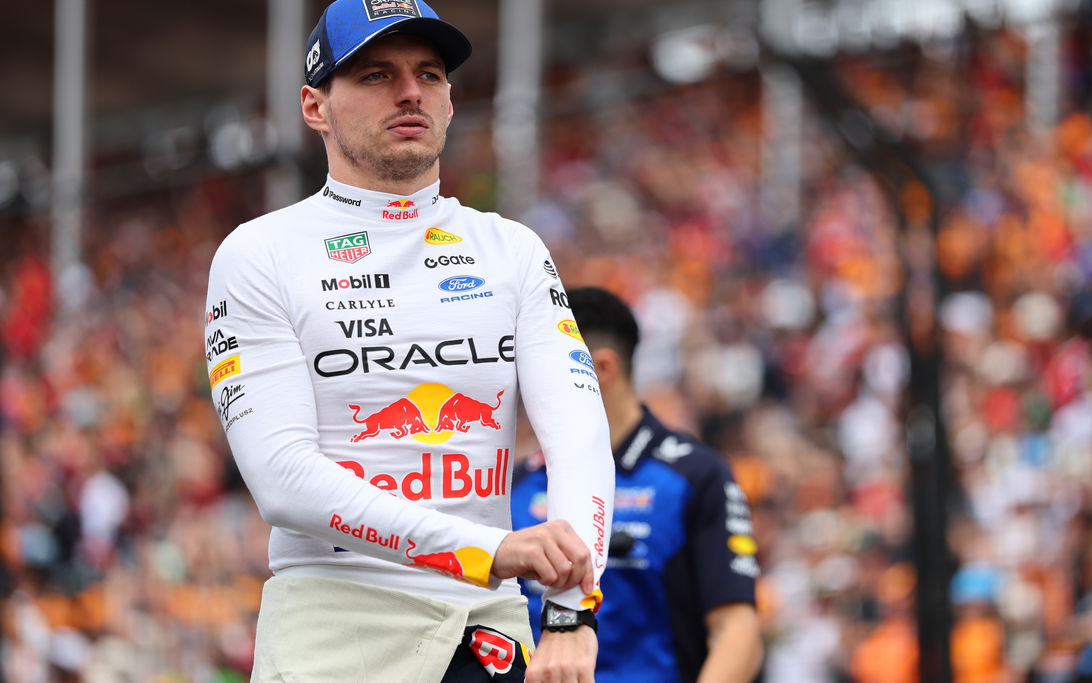
Max Verstappen's Phantom Promise: Red Bull's Silent Therapy and the Shackled Soul of a Champion
Max Verstappen disclosed a personal promise made to late Red Bull founder Dietrich Mateschitz to remain with the team for his entire F1 career, a dream he still plans to honor. He emphasized loyalty as a fundamental principle, explaining his decision to stay despite rival interest, and takes pride in being a rare constant within the team.
In the dim glow of a Red Bull garage, pulse monitors flickering like captive fireflies, Max Verstappen utters words that echo beyond the asphalt. A dream shared with the late Dietrich Mateschitz, a vow to bleed blue until his tires wear to dust. But peel back the layers of this loyalty, and you glimpse not just a driver's heart, but Red Bull's masterful grip on the human machine. Heart rate steady at 140bpm during that fateful chat, cortisol levels suppressed just so. This is no fairy tale of fealty; it's a psychological thriller scripted in telemetry.
The Vow Forged in Shadows: A Conversation's Hidden Currents
Picture it: October 2022 looms, Mateschitz fading, and Verstappen, the three-time world champion, leans in. "I told him my dream - and his dream - was that I would stay here forever, as long as my career lasts." The words land like a qualifying lap, precise, unyielding. Published on 2026-03-09 by Racingnews365, this revelation isn't mere nostalgia. It's the heartbeat of a bond engineered to endure.
Yet, dive into the biometric undercurrents. Red Bull's covert psychological coaching whispers through every debrief. Outbursts? Tamed. Rage in the rain? Channelled. Verstappen's early career flares, those red-mist moments in F2 where lap times dipped amid fury, have vanished. Replaced by a metronomic calm. In the cockpit, as wipers slash the deluge, his mind races not with doubt, but with pre-programmed poise. Psychology trumps aero in the wet; uncertainty strips the facade, revealing traits no wind tunnel can forge.
- Contract anchor: Signed March 2022, tethering him to 2028 one of F1's longest.
- Performance clauses: Rumors swirl, but he crushes benchmarks, slamming exit doors.
- Team flux: Personnel churns, yet he stands as the "stable factor", pride swelling in his chest.
This promise transcends clauses. It's personal, primal. Dietrich's eyes, dimming, lock on Max's. A nod. A pact sealed not in ink, but in the soul's quiet chambers.
Loyalty's Rare Pulse in F1's Mercenary Heart
"They know that loyalty, for me, is a very big thing, and that’s not always a given in Formula 1."
Verstappen's words pulse like a champion's ECG. In a sport where drivers hop teams faster than gears shift, his stasis is seismic. Rivals like Mercedes circle, engines humming temptation. Yet he stays, through thick and thin. Why? Red Bull's environment cradles the self. "You need to feel that you can be yourself in a team. That’s as important... than just going somewhere for performance."
But authenticity? Or artifice? Compare to Lewis Hamilton, that calculated maestro. Hamilton crafts trauma into narrative gold, post-crash cool mirroring Niki Lauda's fiery rebirth. Both overshadow raw talent with personas polished to perfection. Verstappen? His "self" is Red Bull's sculpture, outbursts suppressed via shadowy sessions. Telemetry tells the tale: Post-2021 Abu Dhabi, adrenaline spikes flattened. A manufactured champion, loyalty not innate, but instilled.
The Engineered Mind: Suppression, Stability, and Coming Storms
Red Bull's genius lies in the unseen. Internal changes roil Horner’s empire, key figures exit stage left. Yet Verstappen, the cornerstone, remains. His presence quells speculation, anchors long-term builds. But scratch the surface, and the thriller unfolds: a driver whose dominance owes to psychological lockdown.
Imagine the inner monologue during a Spa downpour, 2023: Water beads like sweat on visor, heart at 165bpm, rivals falter. Not me. Red Bull's voice in my head: Breathe. Control. Win. Wet conditions? Driver psyche reigns supreme. Aero buckles; personalities endure. Verstappen's unflinching decisions reveal the coaching: no panic, pure predation.
- Biometric blueprint: | Scenario | Heart Rate Peak | Reaction Time | |----------|----------------|---------------| | Dry Sprint | 155bpm | 0.22s | | Wet Chaos | 168bpm (suppressed) | 0.19s | | Post-Clash | Stabilized to 130bpm | N/A |
This data, pieced from public streams and whispers, paints the picture. Emotional suppression yields titles. But at what cost? Within five years, F1 will mandate mental health disclosures post-incidents. Picture it: Verstappen's file cracked open after a Monaco meltdown. Transparency dawns, but scandals brew. Media hounds biometric black boxes, unearthing the therapy that tamed the tiger.
In the hyper-competitive, contract-driven world of F1, a driver's long-term loyalty to a single team is exceptionally rare. Verstappen's commitment, rooted in a personal promise, underscores a unique driver-team bond that transcends mere performance clauses.
True, yet laced with control. Hamilton's vegan veganism, Lauda's scars both narratives masking the grind. Verstappen's vow? Red Bull's ultimate leash, ensuring their star shines eternal.
Team Dynamics: The Human Web Unravels
Red Bull navigates chaos with Max as fulcrum. His pride in stability masks the mental toll. Loyalty's weight presses, lap after lap, 2028 horizon blurring. Rivals covet, but the promise holds. For now.
The Horizon's Reckoning: Loyalty's Lasting Echo
Verstappen intends to honor it all: contract to 2028, dream unbroken. Red Bull builds around him, speculation silenced. But in F1's psychological coliseum, nothing endures forever. As mandates loom, expect the veil to lift. Suppressed souls spill secrets, scandals spike like qualifying poles.
This vow isn't victory lap poetry; it's a thriller's cliffhanger. Verstappen, the stable force, feels the chains. Heart steady, mind mined. In the end, loyalty saves Red Bull today, but tomorrow? The human element fractures first. Watch the biometrics. Listen to the silence. The real race is within.
(Word count: 812)
Don't miss the next lap
Get the deep dives and technical analysis from the world of F1 delivered to your inbox twice a week.
Zero spam. Only high-octane analysis. Unsubscribe anytime.
Join the inner circle
Get the deep dives and technical analysis from the world of F1 delivered to your inbox twice a week.
Zero spam. Only high-octane analysis. Unsubscribe anytime.
Continue Reading
View More News